
Continuous AAV Capture Lifts Yield While Minimizing Preconditioning
A conversation between Julia Müller, University of Applied Sciences and Arts Northwestern Switzerland, and Life Science Connect's Jon O'Connell
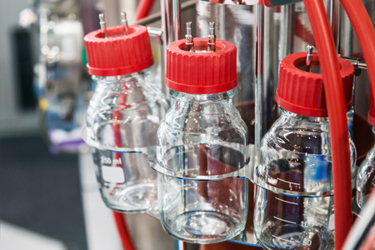
A continuous capture process developed at a Swiss university cut buffer consumption by 79% and lifted recovery by 14.3% and productivity by 11.4% — all without some of the most burdensome preconditioning steps that typically precede AAV capture.
The work, from downstream processing scientist Julia Müller at the University of Applied Sciences and Arts Northwestern Switzerland, pairs extended perfusion culture with twin-column continuous chromatography. Rather than lysing cells and flooding the feed stream with host-cell proteins, DNA, and debris, the approach captures the AAV particles that cells secrete over longer cultivation times, using only hollow fiber and inline filtration to prepare the harvest.
It is, in effect, a downstream answer to upstream’s push for higher titers. As producer cell lines and perfusion processes generate more virus, capture must keep pace without becoming the bottleneck. Müller’s results suggest exactly that, with the payoff growing as titers rise.
We wanted to learn more about the work and, in particular, how promising it looks for clinical- and commercial-scale processing. Müller offered to answer our questions. Our conversation has been edited for clarity.
For our readers who aren't as intimately familiar with AAV capture, can you tell us about the status quo? What were the problematic AAV pretreatment steps that you were trying to solve?
Müller: In a conventional process, chemical cell lysis has the advantage of releasing all the intracellular AAVs, but the trade-off is that it also floods the whole feed stream with a massive amount of host-cell proteins, host-cell DNA, and cellular debris. Managing these impurities later in the process or during clarification is complex and expensive.
DNA digestion with nucleases is often performed to remove host-cell DNA or chop it down into smaller fragments. This also lowers the viscosity, which is good for the subsequent depth filtration. Nonetheless, it’s a major cost driver in AAV manufacturing.
After digestion and depth filtration, tangential flow filtration (TFF) is done before capture. TFF is a whole unit operation that helps to remove smaller impurities, residual DNA fragments and lysis reagents.
We wanted to avoid all these unit operations and instead, leverage the perfusion process.
With our process, there’s no bulk release of the intracellular components. We’re not capturing intracellular particles, but thanks to the extended perfusion process, the natural secretion of particles is favored through longer cultivation times.
Our approach is not an untreated harvest, it's a minimally treated harvest using a 0.4-micrometer hollow fiber membrane coupled to our perfusion reactor. We have another 0.2-micrometer inline filter to remove the final impurities and aggregates that could interfere with the chromatography column.
While we used transient transfection, the approach would also be suitable for stable and inducible producer cell lines.
Can you briefly describe how the capture process works?
Müller: We used a CaptureSMB process on a continuous twin-column chromatography system from YMC ChromaCon in which two columns are operated at the same time.
The principle of CaptureSMB is that you load the two columns in an interconnected mode. The advantage, especially for lower titers where loading times are quite long, is that you can load at a faster flow rate. Generally, if you apply faster flow rates, the breakthrough appears a bit earlier due to the reduced contact time. But when you do that in an interconnected state, you can collect the product that breaks through the first column on the second column — meaning you can load the first column to a much higher capacity utilization.
Once you reach your target capacity utilization, you can operate the columns in a parallel mode, stop the interconnected operation, and recover the product from the first column.
During elution and regeneration, you can continue loading the second column separately. In this way you increase the productivity by applying faster flow rates, but you still don't lose any product because you can capture that on the second column.
Expensive affinity resins are a massive cost driver, and this approach uses them sparingly. We used AVIPure AAV5 resin for capture. Of course, there are plenty of resins on the market, but AVIPure worked best for us in terms of cleanability.

In the results, you saw a recovery improvement and increase in productivity. Did those meet your expectations?
Müller: Yes, we were really pleased, especially given the conditions. Against a conventional batch capture we improved recovery by 14.3% and productivity by 11.4%, and reduced buffer consumption by 79%.
And just as important, the product quality held up. We actually saw lower host-cell protein and lower residual DNA in the early cycles, while the full-capsid ratio, thermal stability and transduction efficiency stayed unchanged compared to batch operation. So, it’s more product, more efficiently, and cleaner, with no trade-off in quality.
What makes these gains especially meaningful is that we achieved them under unfavorable conditions. The titer was on the lower end and the impurity-to-product ratio wasn’t in our favor. We even saw early signs of fouling and had to adjust the loading, which cost us a little productivity. And yet we still managed to outperform the batch. The yield gain was especially nice, because these affinity columns normally recover less at low loading density. Improving yield under unfavorable conditions is a strong signal of how much potential the process has. We expect that the gains would be even better in a more optimized process with higher titers.
The most striking outcome was the 79% buffer reduction, which also cuts liquid waste streams, hold-tank capacity, and the labor needed to prepare buffers. At larger scales the real advantage is automation: continuous operation massively reduces operator handling, and with it the risk of manual mistakes.
Of course, it comes with a trade-off during development — a bit ironically, these processes are harder to develop precisely because they’re so productive; you need a lot of material. But once it’s running, that’s exactly the advantage.
What pretreatment steps, if any, did you have to keep?
Müller: We kept some filtration steps, but we didn't have to do a depth filtration. We harvested the particles using a 0.4-micrometer TFF hollow fiber membrane, which also helps to retain all the cells and larger debris. In addition, we employed a 0.2-micrometer inline filter to reduce bioburden and protect the capture column. But the complex, expensive multistep operations were basically eliminated.
You used AAV5 as a model, but are there any other special considerations for using other serotypes? Is this easily transferable to a different serotype?
Müller: The concept is serotype-independent, but there are certain considerations. When you capture only the extracellular particles that are secreted, it relies on how many particles are secreted by the individual serotype, and this can vary quite a lot.
AAV2, which does not secrete many particles, is probably a less suitable candidate. Other serotypes such as AAV8 and AAV9 are good at secreting particles and would be quite suitable, which is promising given how widely those serotypes are used.
You mentioned fouling as a problem at lower titers. Is this an entrenched issue or something that you believe there's an engineering solution for?
Müller: Maybe a bit of both. From what we've observed so far, it's really more of a solvable ratio problem. With this homogeneous pool of perfusion harvest in the first study, we had really low titers, and the fouling seemed to be a problem after a certain number of cycles. Therefore, we were limited by the number of cycles that we were able to achieve. But later, in a follow-up study where we integrated the perfusion reactor directly with the continuous capture step, we reached much higher titers. Switching times were much shorter, and there we reached a maximum of 17 cycles without these signs of fouling.
It was mostly a ratio problem, but of course I think we can evolve with more engineering. As we move ahead and improve the resins themselves, it will also become easier. We saw the same happening for monoclonal antibodies and protein A.
Engineering resins to improve the caustic stability helps a lot. At the moment, most resins for AAV capture only support 0.1 molar sodium hydroxide, or occasionally 0.5 molar sodium hydroxide, or none at all depending on the resin, so cleanability is still an issue. That is definitely more of an engineering problem to be addressed from the supplier side, and the trajectory is clearly positive.
What steps do you see between now and a clinical- or commercial-ready process?
Müller: We are still in a proof-of-concept phase with our benchtop experiments, and there's more work before we can go full-scale, but the path forward is clear. As I mentioned, in that integrated follow-up study we coupled the perfusion process directly with the capture chromatography step. An optimized process is key, because the benefits scale with what you can achieve upstream. For very low titers, it's probably less compelling under our tested conditions, but for high-titer, high-value processes, this is a very attractive route, as titers across the industry keep climbing. That’s exactly where the field is heading. As titers are climbing, the capture has to keep pace without becoming the bottleneck, and that is exactly what this process is built to do.
About The Expert:
 Julia Müller is a downstream processing scientist at the University of Applied Sciences and Arts Northwestern Switzerland, where her PhD thesis work focuses on continuous chromatography methods for AAV and plasmid DNA. Previously, she held downstream process development roles at Lonza, CSL Behring, and Thermo Fisher Scientific. She received a master's degree in molecular and cellular biology from the University of Bern.