
When Lyophilization Fails At Scale, First Scrutinize Your Formulation
By Devendra Ridhurkar
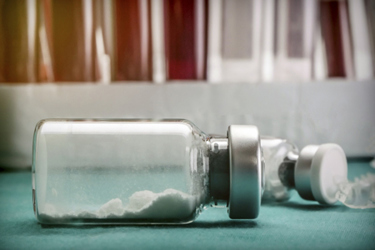
Lyophilization can enhance the storage stability of proteins and other biological molecules, but the process can expose them to various stresses1,2 that can lead to aggregation, potency loss, or capsid damage. To meet the central development challenge3, it is insufficient to simply select stabilizing excipients or design a drying cycle in isolation. Formulation composition and lyophilization process parameters must be codeveloped in an integrated manner, reflecting their interdependence in determining product stability and performance.
To achieve an acceptable cake and a reproducible drying cycle, it is necessary to define early the instability pathway of the molecule, the interaction between excipients under frozen and dried conditions, and formulation-specific thermal and structural limitations. These limitations can be linked to cycle parameters in a systematic manner. For robustness, formulation composition (buffer species, pH range, tonicity modifiers) and lyophilization process parameters (primary and secondary drying conditions) can be co‑optimized through a structured, iterative experimental design.4 This integrated approach defines a portable operating space rather than a single fixed laboratory cycle.
Start With The Molecule To Understand Instability
The first step in developing a lyophilized biologic is understanding how the molecule behaves under freezing conditions compared with its liquid solution state. Baseline characterization — such as primary structure integrity, secondary/tertiary structure, aggregation propensity, thermal stability, and sensitivity to pH and ionic strength — allows developers to distinguish inherent instability from freezing‑induced changes.
Freezing introduces two major stress pathways:
Cryoconcentration
As ice forms, solutes become concentrated in the unfrozen phase, causing shifts in pH, ionic strength, buffer composition, and excipient ratios. These changes can trigger aggregation or structural perturbation even when the liquid formulation is stable.
Interfacial Stress
Ice-liquid and air-liquid interfaces increase dramatically during freezing. Proteins adsorb and unfold at these interfaces5, generating aggregates and particles.
Candidate formulations should therefore be screened under representative freezing and freeze-thaw conditions, ensuring that excipients, buffers, and surfactants remain functional in the freeze‑concentrated state.
Build The Formulation Around The Molecule
Buffer Selection Based On Frozen‑State Behavior
Buffer identity and concentration must be evaluated under frozen conditions, not only at room temperature. Selective crystallization or exclusion of buffer components can shift pH significantly.6 For example, sodium phosphate systems may undergo large pH excursions upon freezing. Buffer screening should therefore include frozen-state pH, ionic strength, crystallization behavior, and compatibility with excipients and protein critical quality attributes (CQAs). This reduces the risk of selecting a buffer that performs well in liquid but destabilizes the molecule when frozen.
Cryo- And Lyoprotectants: Formulation‑Specific Selection
Sugars such as sucrose and trehalose provide cryo‑ and lyoprotection by stabilizing proteins during freezing and forming amorphous matrices during drying. Their performance, however, depends on sugar‑to‑protein ratio; buffer ionic strength; interactions with mannitol, arginine, and surfactants; and crystallization tendencies during freezing or storage.
Recent studies show that acceptable stability can be achieved at lower sugar‑to‑protein ratios, provided the surrounding formulation is optimized. Sugar concentration should be selected to balance protection with viscosity, cake structure, and drying performance.
Bulking Agents: Balancing Structure And Stabilization
Bulking agents such as mannitol provide mechanical strength by crystallizing, while amorphous sucrose provides stabilization. Mannitol-sucrose systems illustrate the need to balance crystalline and amorphous phases to achieve robust cake structure, acceptable drying constraints, and stable solid‑state behavior. When properly formulated, crystallized mannitol can promote the penetration of the reconstitution medium and enhance the disintegration of cakes.7 Secondary drying must be controlled to avoid formation of unstable mannitol hydrates. Salt interactions must also be considered, as eutectic behavior can influence both freezing and drying.
Surfactants: Managing Interfacial Stress
Surfactants such as polysorbate 20 reduce interfacial adsorption and aggregation during freezing and reconstitution.8 Their concentration must be optimized to provide protection without introducing new stability or analytical concerns. Poloxamer 188 may enhance frozen‑state stabilization9 but does not replace sugar‑based lyoprotectants; it should be used as a complementary excipient.
Develop The Lyophilization Cycle With The Formulation
Freezing Strategy And Critical Temperatures
Cooling rate, nucleation temperature, and vial heat transfer determine ice‑crystal size distribution, which controls pore structure, drying resistance, and reconstitution behavior. Controlled nucleation has been shown to improve cake uniformity, reconstitution performance, and drying efficiency.10. Freezing should be treated as a designed unit operation, not a fixed preprocessing step. In the case of amorphous systems, Tg' (glass transition of the maximally freeze-concentrated solute) is an important upper-temperature criterion, but it should not be regarded as the sole relevant criterion. It is also necessary to consider issues such as product collapse, structural changes, vapor flow resistance specific to some formulations, and protein stability. Controlled nucleation and formulation‑specific thermal limits are often beneficial in the case of monoclonal antibodies (mAbs).
Primary Drying
Primary drying removes ice by sublimation. Shelf temperature and chamber pressure must remain within formulation‑specific thermal and structural limits. Differential scanning calorimetry and microscopy help identify Tg', collapse temperature, excipient crystallization, and protein stability limits. Some high‑protein amorphous systems can be dried above Tg' without compromising quality, demonstrating that Tg' should not be used as an automatic limit. The operating window must be supported by product‑quality data.11
Secondary Drying And Residual Moisture
Residual moisture should be optimized and not minimized. Depending on solid‑state properties, storage conditions, and protein stability, excessive drying can be as detrimental as insufficient drying. For example, drying conditions must avoid linker degradation or aggregation in the case of antibody-drug conjugates (ADCs).
Formulation-Process Interaction And Operating Space
Modern lyophilization increasingly incorporates AI‑driven cycle optimization; digital twins for heat/mass transfer modeling; predictive analytics for collapse, meltback, and crystallization; and continuous lyophilization platforms. These tools12-13 accelerate development, reduce experimental burden, and support robust scale‑up.
Define CQAs And The Analytical Strategy
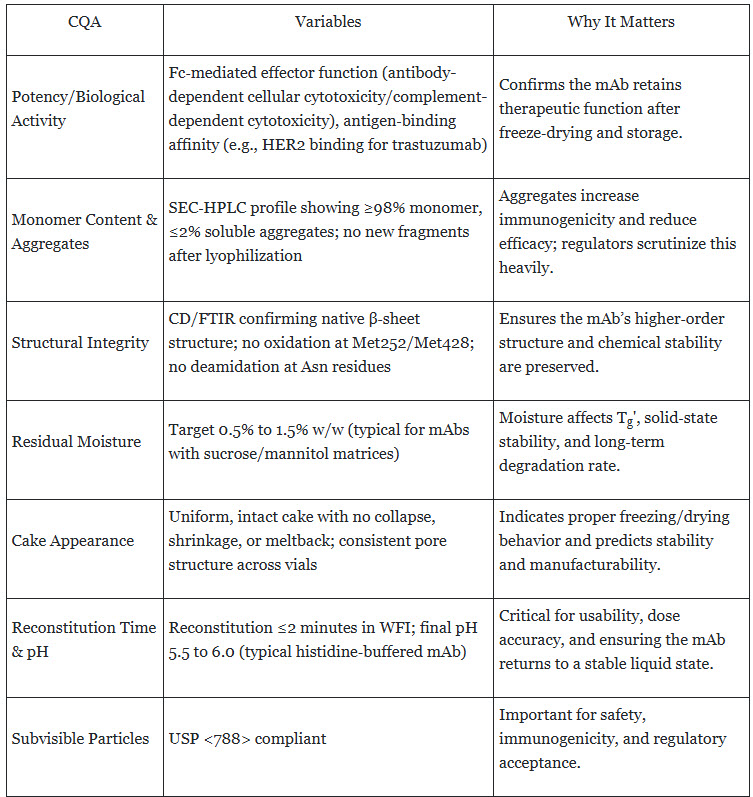
Quality by design (QbD) links material attributes and process parameters to CQAs through risk assessment, design of experiments (DoE), and process characterization. A modern lyophilization strategy should identify variables affecting:
- product temperature,
- drying resistance,
- residual moisture,
- reconstitution, and
- molecular stability.
Use DoE to evaluate formulation variables and critical process parameters systematically; apply process analytical technology (PAT) tools (temperature probes, pressure-rise tests, mass‑loss monitoring); verify model‑based approaches within defined applicability domains; and define acceptable ranges rather than relying on a single successful recipe. Each CQA should be linked to its failure mechanisms (Table 1) and the formulation/process variables that influence them.
Modern biologics increasingly require compatibility with dual‑chamber syringes, autoinjectors, on‑device reconstitution systems, and high‑concentration delivery formats. Reconstitution performance becomes a functional CQA. Developers should evaluate cake structure and pore connectivity, crystallinity, protein‑to‑excipient ratio, diluent volume and temperature, vial geometry and headspace pressure, and swirling or mixing strategy. High‑concentration products14 require special attention to viscosity, reconstitution time15, and presentation effects (bubbles, clarity).16 For bispecific/multispecific antibodies, structural heterogeneity requires tailored CQAs and analytical methods. Antigen integrity, potency, particulate behavior, and reconstitution performance must be evaluated alongside cake structure and moisture in the case of vaccines. Formulations for AAV serotype 8 (AAV8), a specific viral vector used widely in gene therapy development, should optimize buffer/salt concentrations, cryo‑/lyoprotectants, surfactants, and bulking agents.17 In addition, the mannitol-to-sucrose ratio strongly influences cake stability and appearance in this case.
Table 1: Example CQAs for a monoclonal antibody
Scale-Up And Technology Transfer
Why A Laboratory Cycle Cannot Simply Be Copied
Laboratory cycles rarely transfer directly to pilot or commercial dryers due to differences in shelf geometry, heat transfer, condenser capacity, pressure control, loading density, fill volume, and freezing behavior. Technology transfer must be based on product temperature and heat/mass transfer behavior, not simply shelf‑temperature and pressure setpoints.
Kv, Rp, And The Physical Basis Of Transfer
Kv (vial heat‑transfer coefficient) and Rp (product resistance) together determine sublimation rate and product temperature. Kv describes heat transfer from the dryer to the vial. It varies with vial type, pressure, equipment configuration, and vial position. Rp describes resistance of the dried layer to vapor flow. It depends on freezing conditions, ice‑crystal structure, fill depth, and formulation. Scale‑up requires characterization of Kv and Rp for the receiving equipment and control of vial type, fill depth, freezing history, and formulation composition.
Chamber Pressure, Shelf Temperature, And Endpoint Determination
Each dryer has unique pressure‑control and condenser performance. Endpoint determination should use pressure‑rise tests, product‑temperature behavior, mass‑loss measurements, and PAT tools.18 The endpoint must ensure complete ice removal without unnecessary cycle extension.
Vial And Fill Configuration
Heat transfer and vapor flow can be affected by the dimensions of the vial and the volume of its fill, the depth of its fill, the size of its stopper, and the loading pattern. Therefore, the factors mentioned above should be held constant or explicitly taken into account in the transfer process. Comparing the behavior of edge vials and center vials is important, particularly when receiving equipment has a significantly different shelf geometry or loading density.
Expand Lyophilization To New Biologic Modalities
Even though principles of freezing, stabilizing, drying, and reconstituting are similar across biologic methods, the relevant degradation pathways and critical quality assurances differ from one method to another. Formulation and cycle should be tailored to the molecule instead of assuming that a successful platform cycle can be adapted to another modality without modification.
Monoclonal Antibodies
In the development of mAbs, the goals are to maintain molecular integrity, limit the formation of aggregates and particles, preserve potency, and achieve an optimal cake and reconstitution profile. During the cycle-development process, nucleation control and formulation-specific thermal limits can be considered.
Bispecific And Multispecific Antibodies
Bispecific and multispecific antibodies may require additional consideration because of their structural heterogeneity as well as product-specific aggregation or activity risks. It is important to adhere to the same formulation-process framework, but CQAs and analytical methods should be chosen in accordance with the architecture and mechanism of action of the molecule.
Antibody-Drug Conjugates
It is imperative that the formulation development of ADCs preserves both the biologic component and the properties of the conjugated drug-linker. In this regard, it is particularly important to evaluate the drying process in terms of effects on aggregation, molecular integrity, potency, and any pathways for chemical or physical degradation specific to the product.
Recombinant Proteins And Enzymes
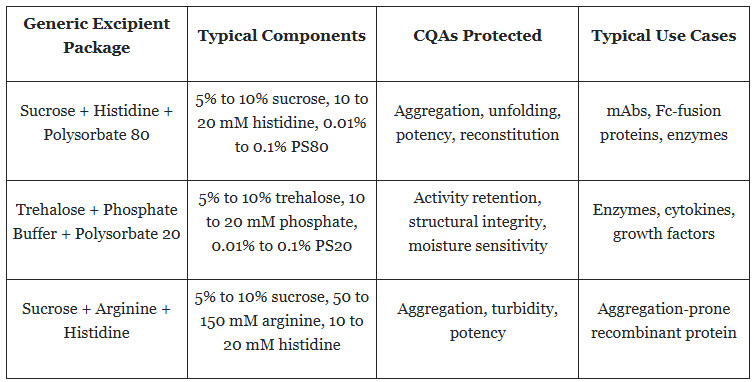
Recombinant proteins and enzymes may be sensitive to changes in pH, interfaces, aggregation, and dehydration depending on their formulation. To optimize buffer behavior, sugar protection, surfactant concentration, and residual moisture, it is better to use an excipient package (Table 2) that is based on the relevant activity and structural CQAs.
Table 2: Examples of generic excipient packages for recombinant proteins and enzymes
Vaccines
There are several types of vaccines, including proteins, antigens, adjuvant-associated components, and other biologically active materials with different stability requirements. To optimize lyophilization, it is therefore necessary to consider antigen integrity, potency, particle or particulate behavior, and reconstitution performance on top of conventional cake and residual moisture characteristics.
Viral Vectors And Gene Therapy Products
The use of viral vectors introduces an additional degree of sensitivity to the formulation composition and processing conditions, such as freezing, drying, and storage. There is evidence that lyophilized AAV8 products can be refrigerated. The concentrations of buffers, salts, cryo-/lyoprotectants, surfactants, and bulking agents must be optimized; the ratio of mannitol to sucrose is also critical for cake stability and appearance.17 Moreover, this example illustrates the principle that newer modalities require modality-specific19 formulations and processes rather than simply applying conventional protein cycles to them.
Build A Transferable, Modality-Specific Lyophilization Strategy
Developing robust lyophilized biologics requires integrated formulation-process design, modern analytical and modeling tools, and early consideration of scalability, modality‑specific degradation pathways, and device compatibility. Viral vectors and gene therapy products are highly sensitive to freezing, drying, and storage. As part of technology transfer, it is imperative to address reconstitution and scale-up before the process can be deemed mature, and to consider Kv, Rp, vial/fill configuration, differences in equipment, endpoint criteria, and transferable operating space. As a final point, quality by design, process analysis and modeling, as well as mechanistic process knowledge, can transform a laboratory recipe into a robust manufacturing strategy. Monoclonal antibodies, multispecific antibodies, ADCs, recombinant proteins and enzymes, vaccines, viral vectors, and gene therapy products can also be treated according to the same principles as long as modality-specific degradation pathways and CQAs are recognized. Essentially, the goal is to develop a formulation and lyophilization process that consistently produces products of the required quality, storage stability, reconstitution performance, and robustness in manufacturing.
References:
- Wang W. Lyophilization and development of solid protein pharmaceuticals. Int J Pharm. 2000;203(1-2):1-60. doi:10.1016/S0378-5173(00)00423-3.
- Bjelošević M, Zvonar Pobirk A, Planinšek O, Ahlin Grabnar P. Excipients in freeze-dried biopharmaceuticals: Contributions toward formulation stability and lyophilisation cycle optimisation. Int J Pharm. 2020;576:119029. doi:10.1016/j.ijpharm.2020.119029.
- Maharjan R, Shin CY, Lee S‑K, Ha E‑S, Park H, Kim J‑S, Kim KH, Kim NA, Kim M‑S, Jeong SH. Stabilization strategies and advancements in lyophilization to preserve integrity and efficacy of next‑generation biologicals. Int J Pharm X. 2026;11:100195. doi:10.1016/j.ijpx.2026.100195.
- Cheng Y, Duong HTT, Hu Q, Shameem M, Tang XC. Practical advice in the development of a lyophilized protein drug product. Antib Ther. 2025;8(1):13-25. doi:10.1093/abt/tbae030.
- Kasper JC, Friess W. The freezing step in lyophilization: physico-chemical fundamentals, freezing methods and consequences on process performance and quality attributes of biopharmaceuticals. Eur J Pharm Biopharm. 2011;78(2):248-263. doi:10.1016/j.ejpb.2011.03.010.
- Pikal-Cleland KA, Cleland JL, Anchordoquy TJ, Carpenter JF. Effect of glycine on pH changes and protein stability during freeze-thawing in phosphate buffer systems. J Pharm Sci. 2002;91(9):1969-1979. doi:10.1002/jps.10184.
- Kulkarni SS, Suryanarayanan R, Rinella JV Jr, Bogner RH. Mechanisms by which crystalline mannitol improves the reconstitution time of high concentration lyophilized protein formulations. Eur J Pharm Biopharm. 2018;131:70-81. doi:10.1016/j.ejpb.2018.07.022.
- Zhou C, Qi W, Lewis EN, Randolph TW, Carpenter JF. Reduced subvisible particle formation in lyophilized intravenous immunoglobulin formulations containing polysorbate 20. J Pharm Sci. 2016;105(8):2302-2309. doi:10.1016/j.xphs.2016.05.013.
- Li J, Munjal B, Zeng C, Suryanarayanan R. Dual functionality of Poloxamer 188 in freeze-dried protein formulations: a stabilizer in frozen solutions and a bulking agent in lyophiles. Mol Pharm. 2024;21(5):2555-2564. doi:10.1021/acs.molpharmaceut.4c00108.
- Chen Y, Kleppe M, Sharma S, Ingram S, Shameem M, Tang X. Improving the CQAs and lyophilization process efficiency of freeze-dried monoclonal antibody drug products using controlled ice nucleation technology. Pharm Res. 2025;42(11):2111-2124. doi:10.1007/s11095-025-03930-3.
- Overcashier DE, Patapoff TW, Hsu CC. Lyophilization of protein formulations in vials: investigation of the relationship between resistance to vapor flow during primary drying and small-scale product collapse. J Pharm Sci. 1999;88(7):688-695. doi:10.1021/js980445+.
- Zhu T, Moussa EM, Witting M, Zhou D, Sinha K, Hirth M, et al. Predictive models of lyophilization process for development, scale-up/tech transfer and manufacturing. Eur J Pharm Biopharm. 2018;128:363-378. doi:10.1016/j.ejpb.2018.05.005.
- Vanbillemont B, Arsiccio A, Menzen T, Hawe A. Optimization and transfer of robust primary drying protocols for biopharmaceuticals through lyophilization process modeling. AAPS Open. 2025;11:13. doi:10.1186/s41120-025-00115-5.
- Kulkarni SS, Patel SM, Bogner RH. Reconstitution time for highly concentrated lyophilized proteins: role of formulation and protein. J Pharm Sci. 2020;109(10):2975-2985. doi:10.1016/j.xphs.2020.05.029.
- Zhang X, Zhou N, Yang C, Jin Z, Guo J. Multiple approaches to reduce reconstitution time of lyophilized drug products with high protein concentration. Antib Ther. 2024;7(1):67-76. doi:10.1093/abt/tbad031.
- Gao H, Du CY, Zheng A, Qian C, Fang WJ. Formulation factors affecting the formation of visible-bubbles during the reconstitution process of freeze-dried etanercept formulations: protein concentration, stabilizers, and surfactants. AAPS J. 2025;27(1):29. doi:10.1208/s12248-024-01009-2.
- Zhi L, Chen Y, Lai KYN, et al. Lyophilization as an effective tool to develop AAV8 gene therapy products for refrigerated storage. Int J Pharm. 2023;648:123564. doi:10.1016/j.ijpharm.2023.123564.
- Sonje J, Thakral S, Krueger SN, Suryanarayanan R. Enabling efficient design of biological formulations through advanced characterization. Pharm Res. 2023;40(6):1459-1477. doi:10.1007/s11095-023-03495-z.
- Khatoon S, Haque S, Saleem I, Khan FH. Lyophilization of biologics: innovations, challenges, and future directions in stabilizing next-generation therapeutics. Crit Rev Biotechnol. 2026;46(5):837-859. doi:10.1080/07388551.2026.2652316.
About The Author:
Devendra Ridhurkar, Ph.D., is the founder and CEO of RidNova Pharmaceuticals, a specialty pharmaceutical company based in Barcelona, Spain, focused on developing its own differentiated and complex drug products while partnering with pharmaceutical, biotech, and innovator companies globally. RidNova provides strategic and technical expertise across product development, CMC (chemistry, manufacturing, and controls), advanced drug delivery, and commercialization. He has nearly 20 years of pharmaceutical R&D experience, and his expertise spans multiple therapeutic modalities and drug-delivery technologies, including the application of AI and PAT in pharmaceutical development and manufacturing. He previously held scientific and leadership roles at Adalvo, Neuraxpharm, Servier, and Dr. Reddy's Laboratories. He received his Ph.D. in pharmaceutics and drug delivery systems from IIT-BHU, India.