
The Missing Layer: Why CAR-T Needs AI As Its Connective Tissue
By Sanjay Srivastava, Ph.D., cell and gene therapy lead, life sciences IX.0/SCO practice; Deepanjan Roy, strategy senior manager; Josh Taylor, strategy senior manager; Navneet Sharma, consulting manager; Adam Boyer, management consultant; and Quinn Civik, strategy consultant at Accenture

Despite seven FDA-approved CAR-T therapies and nearly 190 authorized treatment centers (ATC) in the U.S., only 10% to 20% of eligible patients receive treatment. Geographic access barriers and the concentration of delivery at academic medical centers (AMC) significantly limit access.
~20%Eligible Patients Treated Only 10–20% of eligible patients receive CAR-T despite seven FDA-approved therapies1 |
190Authorized Centers in US2 Yet 30% of high-cancer-incidence U.S. districts have no CAR-T center3 |
49%Reduced Likelihood Living more than 25 miles from a center cuts the probability of receiving CAR-T by nearly half4 |
A Structural Shift in CAR-T Delivery
While expansion in AMC-led CAR-T delivery will partially solve the demand, it does not completely solve geographic access disparities. Major manufacturers are increasingly shifting toward community and outpatient delivery models.
1/3Community Hospital Sites Approximately one-third of CARVYKTI sites are regional or community hospitals5 |
~35%Community Trial Sites Of CAR-T trial sites are now community-based5 |
45%Outpatient Treatments Of CAR-T treatments were delivered in outpatient settings in 20256 |
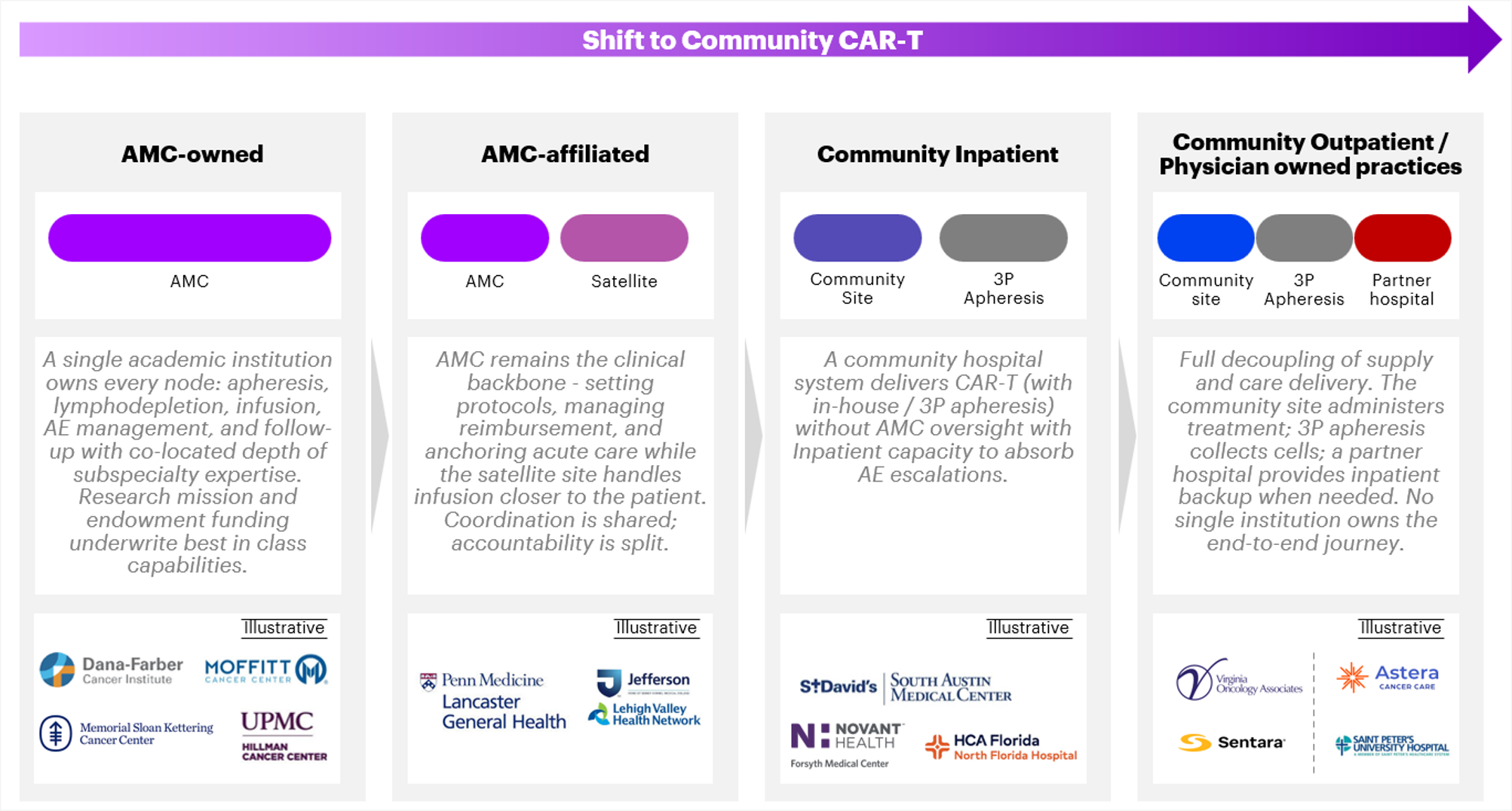
Figure 1: CAR-T delivery models
Click for full size
AMCs held a monopoly by default — these institutions anchored delivery, but only for patients who could reach them. The AMC-affiliated model extends reach through satellite campuses and community partners under academic oversight. Accountability is shared, but therapy now reaches patients who previously had no local option.
However, true access at the hyperlocal level will be unlocked by community-led delivery through larger in-patient systems and physician owned practices.
Community Delivery Unlocks Access — It Also Fractures Coordination
While not all community hospitals are suited for cell therapy delivery, for sites already delivering T-cell engagers (TCE) have established ICU access/local hospital partnerships and centers that offer transplants, delivering bi-specifics and most likely CAR-T becomes feasible. As manufacturers shift to suitable community hospitals to facilitate better patient access, the decoupling of supply and care delivery nodes leads to an even more fragmented continuum of care and amplifies orchestration complexities across the vein-to-vein journey. This fragmentation is most acute in eligible physician-owned practices, where patient handoffs span multiple independent enterprises — third-party apheresis, partner hospitals, logistics providers — across the care continuum.
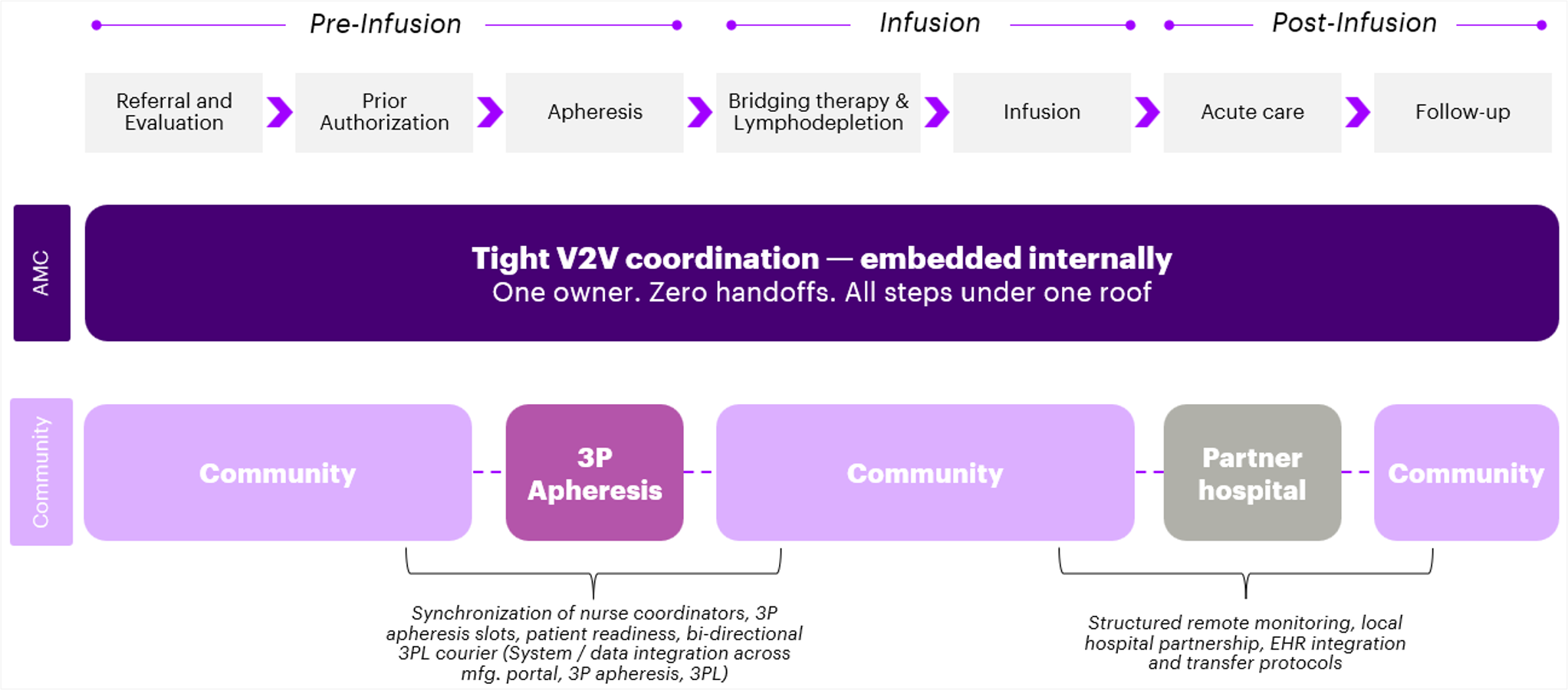
Figure 2: AMC vs. Community - Journey Comparison
Click for full size
The AMC modelVein-to-vein activities tightly coordinated within a single institution. In-house apheresis, cell processing, and acute care — all under one roof. Single accountability. Minimal handoff risk. |
The Community modelDistributed across five or more independent organizations on separate systems, scheduling in isolation, communicating by email and phone. Increased risk of delays, handoff failures, and patient attrition. |
Critical Failure Points Across The Patient Journey End-To-End
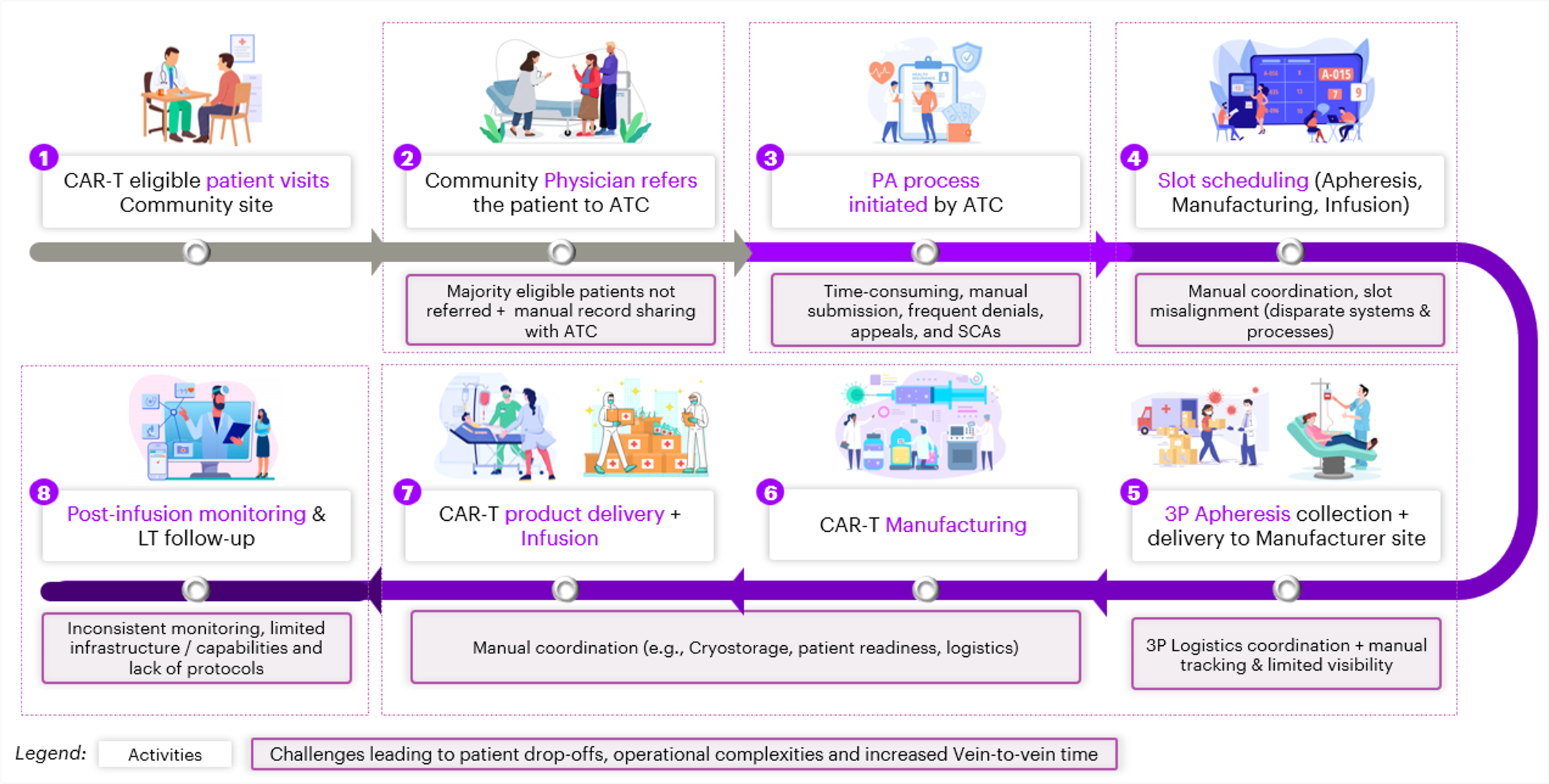
The CAR-T journey in community settings is acutely fragmented — from eligibility identification to long-term follow-up. Each step carries operational failure points that compound into significant patient attrition.
Figure 3: Key challenges across the journey leading to patient drop-offs
Click for full size
Gaps in patient identification and referral
Community attrition begins before any clinical decision is made. Without standardized eligibility screening tools, identifying a CAR-T candidate depends on manual chart review, and even when a candidate surfaces, most practices lack the navigators and referral infrastructure to act.
But the deeper barrier is cultural: academic oncologists are rewarded for early adoption of advanced therapies; community oncologists optimize for volume, where referring out often means losing a patient and associated revenue — a structural disincentive that compounds operational gaps leaving eligible patients unidentified or held locally until the treatment window narrows.
Prior authorization and reimbursement delays
Financial clearance has become its own attrition event. Community sites typically lack standing payer contracts, triggering single-case agreements for the majority of commercially insured patients — single case agreements (SCA) are required in 66% to 68% of private-insurance cases.7 These one-off negotiations nearly double decision-to-vein time, extending median brain-to-vein time from 17 days to 33 days.8 First-submission denial rates run at 31%.9 Community practices absorb this burden with smaller back-office teams and less payer capital than AMCs. The system isn't broken; it was never designed for community-scale CAR-T.
Orchestration complexities across the vein-to-vein journey
Community CAR-T spans five or more independent organizations — each on separate systems, scheduling in isolation, communicating by email and phone. A cryopreserved product viable for 24-72 hours cannot wait for a patient who isn't ready. No existing platform manages this coordination well. The handoffs are manual, fragile, and when they fail, invisible — until a treatment is delayed or a product is lost.
Breakdown in post-infusion risk detection and response
Cytokine release syndrome (CRS) and immune effector cell-associated neurotoxicity syndrome (ICANS) are time-sensitive: early detection determines whether a patient is managed at home or escalates to the ICU. In community settings, monitoring depends on remote infrastructure, informal hospital partnerships, and staff who may see only a handful of CAR-T patients per year. When monitoring is reactive and escalation packets are assembled at the moment of crisis, toxicity advances before intervention. For a therapy where hours matter, responding rather than anticipating is another failure point in an already fragmented journey.
Four Gaps, One Common Root
The four challenges above share a common root: the community CAR-T journey lacks the connective tissue to coordinate care across institutional boundaries at the speed and precision the therapy demands. Ideally, industry requires a single solution that closes the gap on all four through:
Early visibility
Identify eligible patients automatically at the point of care, before disease progression closes the treatment window.
Frictionless reimbursement
Predict, navigate, and resolve prior authorization (PA) and SCA complexity without consuming the clinical staff needed for patient care.
End-to-end orchestration
Align every stakeholder on a single real-time timeline — apheresis, manufacturing, logistics, infusion — with no room for manual error.
Always-on safety
Monitor every patient continuously after infusion, detect toxicity before clinical deterioration, and escalate automatically when it matters most.
No manual process delivers all four consistently; artificial intelligence does.
AI As The Connective Tissue The Journey Has Been Missing
The answer is not another point solution. What CAR-T requires is an end-to-end AI platform — one that spans every stage of the patient journey, from eligibility identification through post-infusion monitoring, and replaces fragmented, manual handoffs with intelligent, automated workflows.
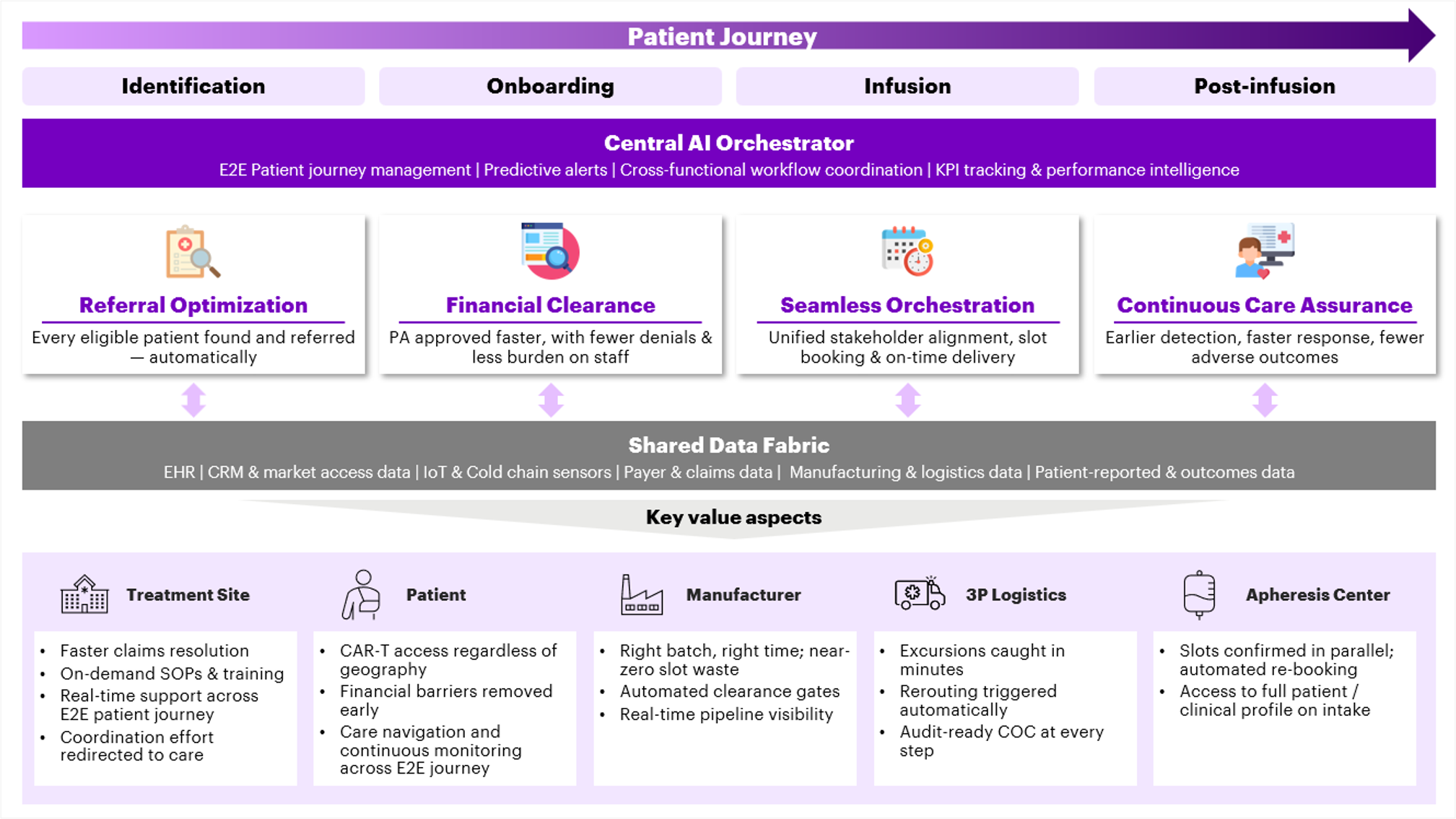
The platform operates through a layered architecture: an overarching orchestrator governing specialized AI solutions/super agents (referral optimization, financial clearance, etc.) across the vein-to-vein journey, all built on a unified data fabric that serves as the connective tissue of the community CAR-T ecosystem. Each AI solution leverages the appropriate data sources, applies targeted intelligence, and initiates timely actions to eliminate delays, reduce manual intervention, and improve coordination.
Common data fabricThe connective tissue of the community CAR-T ecosystem — integrating stakeholders, systems, and workflows across the end-to-end patient journey. |
Targeted intelligenceEach AI solution leverages the appropriate data sources, applies targeted logic, and initiates timely actions to eliminate delays and reduce manual intervention. |
Automated workflowsFragmented handoffs replaced with intelligent, automated workflows. Critical decisions informed in real time. Operational bottlenecks anticipated before they occur. |
Figure 4: AI solution architecture and value aspects for key stakeholders
Click for full size
4 High-Impact AI Solutions For End-To-End Coverage
Each solution theme addresses a critical failure point within the CAR-T journey. Collectively, they power AI-enabled workflows that improve access, accelerate treatment timelines, and enhance patient outcomes across the vein-to-vein continuum.
1. Referral Optimization
Find the patient before the window closes.
Embed eligibility intelligence directly into clinical workflows to proactively identify the right patients before disease progression limits treatment eligibility.
- Community oncologist — eligible patients flagged automatically in workflow; no missed windows, no manual review.
- CAR-T coordinator — complete referral package auto-generated; intake back-and-forth eliminated.
- Patient — identified weeks earlier, at better performance status, with a real chance at treatment.
The SCA Burden In Detail
Unlike standard prior authorizations, SCAs involve complex negotiations covering reimbursement rates, clinical justification, treatment scope, and financial terms. The process is typically manual, fragmented across multiple stakeholders, and heavily dependent on email, phone calls, and document exchanges — adding weeks of delay to every case. The CAR-T AI Platform streamlines the SCA process by automating documentation assembly, identifying missing requirements before submission, and guiding requests through the most effective approval pathways based on historical payer behavior and outcomes.
2. Financial Clearance
Kill the eligibility bottleneck.
Automate the end-to-end financial clearance process by generating documentation, predicting denial risk, and routing submissions through optimal approval pathways.
- Back-office staff — PA/SCA structured, submitted, and tracked automatically; effort shifts to exceptions only.
- Treating physician — clinical justification drafted from EHR data; approval secured with minimal administrative burden.
- Site leadership — real-time tracking and higher predictability; administrative workload reduced and cash flow risk minimized.
3. Seamless Orchestration
No phone calls, no spreadsheets, no gaps.
Create a unified orchestration layer (control tower) that connects EHRs, apheresis centers, logistics providers, and manufacturer systems to anticipate and resolve operational disruptions before they impact patient care.
- CAR-T coordinator — apheresis, manufacturing, and infusion aligned in parallel; scheduling mismatches and manual coordination eliminated.
- Third-party logistics partners — cold-chain deviations predicted before they occur; excursions prevented, not discovered.
- Manufacturer — confirmed schedules and readiness signals received automatically; slot waste and batch failures reduced.
4. Continuous Care Assurance
24/7 eyes on every patient.
Enable continuous AI-supported post-infusion surveillance that detects emerging risks early and supports evidence-based intervention, extending specialist-level oversight to outpatient settings.
- Oncologist (ATC) — graded toxicity alert with evidence-based protocol before clinical deterioration; specialist-level guidance at point of care.
- Patient — continuous monitoring replaces reactive ER visits; safe recovery at home becomes the standard, not the exception.
- Partner hospital — structured escalation packet auto-generated at threshold; no information gaps, no delays in handoffs.
The Reimagined CAR-T Journey
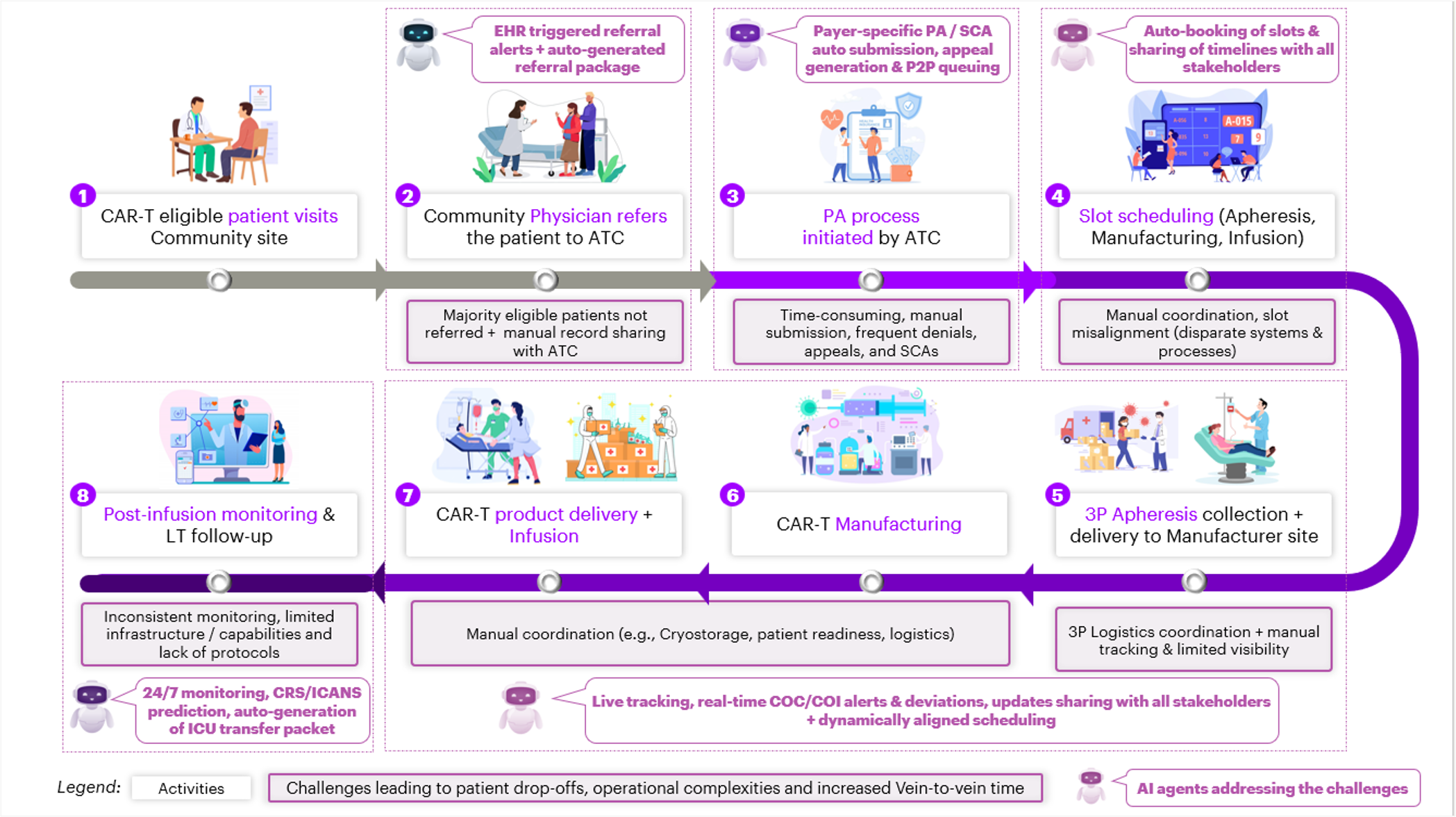
The CAR-T AI platform converts fragmented handoffs into automated, orchestrated workflows — enabling real-time, intelligent, and faster care pathways.
Figure 5: Illustrative AI-enabled CAR-T journey with seamless multi-enterprise orchestration
Click for full size
| Step | From… | …To |
|---|---|---|
| Patient identification & referral | Missed eligibility and delayed referrals | Proactive patient discovery and automated referral activation |
| Prior authorization & clearance | Manual approvals and SCA bottlenecks | Intelligent authorization and accelerated payer clearance |
| Capacity & slot scheduling | Sequential scheduling and resource conflicts | Synchronized capacity orchestration across the care pathway |
| Logistics, manufacturing & delivery | Fragmented coordination and limited visibility | Predictive end-to-end supply chain orchestration |
| Post-infusion monitoring | Reactive toxicity management | Continuous monitoring and proactive intervention |
What It Takes To Build This: The Case for Pre-Competitive Collaboration?
The end-to-end CAR-T AI platform — spanning eligibility identification, prior authorization automation, logistics orchestration, and post-infusion monitoring — functions as foundational infrastructure rather than a source of competitive differentiation. A community oncologist who can navigate a single AI-powered referral workflow, a standardized PA engine, and a unified cold-chain control tower will prescribe more CAR-T across all therapies, not selectively favor the manufacturer that built the tools.
The public-goods dilemma
A single manufacturer that invests in a comprehensive AI orchestration layer risks subsidizing a capability its competitors will free-ride on, while that same investment does little to shift market share in a setting where community oncologists are choosing between therapies based on clinical performance, not which portal they prefer.
The category will scale faster if the platform is built once, governed neutrally, and competed on at the layer of therapy performance, patient experience, and service — not infrastructure.
A scalable CAR-T ecosystem is unlikely to be supported by a single end-to-end community care model. Instead, sustainable access will require a coordinated network of provider archetypes, with clearly defined roles and seamless patient handoffs.
For manufacturers, the larger opportunity is to align around a common AI-enabled orchestration standard rather than create competing, therapy-specific platforms that add complexity for already burdened community practices. The objective should be to compete on therapeutic outcomes — not on which portal, workflow, or technology stack a community oncologist must navigate.
Precedents exist in other industries. Automakers ultimately converged on shared EV charging standards rather than maintaining proprietary networks. Similarly, airline alliances transformed fragmented international travel by creating common operating standards that allowed competitors to share bookings, coordinate journeys, and deliver seamless customer experience. CAR-T may require a comparable model: independent organizations connected through shared standards, interoperable workflows, and unified experience for providers and patients.
A pre-competitive consortium — convening manufacturers, specialty distributors, and a neutral data-governance body — is the natural vehicle to fund, build, and steward this shared layer, converting what today is a collective action problem into a category growth accelerant.
Coming in Part 2
The right-fit integrated human + AI operating model — detailing AI solution themes, aligning data and decision authority, and enabling end-to-end orchestration of AI agents for community-scale CAR-T delivery.
References:
- CAR-T vision 2025, Fred Hutch News
- Unique list of CAR-T sites based on manufacturers’ official websites
- >7.2new cases per 100,000 people based on US CDC
- ASH publications
- Legend Biotech Corporation, Q3 2025 Earnings Call, Nov 12, 2025
- Guidehouse Analysis of McKesson Compile Patient Ready Data (U.S.). Data cut-off date, January 1, 2026.
- Gromowsky MJ et al. Blood Immunology & Cellular Therapy, 2025. https://www.sciencedirect.com/science/article/pii/S3050597625000132
- Gromowsky M et al. ASH Abstract 258, 2023. https://ashpublications.org/blood/article/142/Supplement%201/258/502602
- AMA 2024 Prior Authorization Physician Survey (cross-specialty; n=1,000).
ama-assn.org