
Single-Use Technology: The Next 5 Challenges To Conquer
By Graeme Proctor, single-use technology product manager, Parker Bioscience Filtration
Now that single-use technology plays a part in nearly all bioproduction processes, what is next? Several challenges remain...
These challenges are still serious enough to delay or even stop the use of single-use technology, which in turn can extend the time to market and increase the cost of lifesaving biopharmaceutical products.
Of the existing difficulties, which five are most critical?
Challenge 1: The changing scale of single-use operations
While single-use processing has limitations with scale of operations when compared to stainless steel setups, several trends are mitigating the impact of these limitations significantly:
- increased titers are driving a significant reduction in the size of bioreactors
- the move towards an increased number of smaller, localized manufacturing sites is addressing the requirements for domestic supply
- the growth of personalized medicine and targeted treatments based on genetic profiles are requiring much smaller batch sizes than some of the blockbusters of the past.
These trends, which ultimately lead to a decrease in batch size, allow single-use technology to meet the production requirements for the processes that have previously been dominated by traditional stainless steel setups. Smaller batch sizes also offer better flexibility to adjust to customer needs and to mitigate risk in the supply chain.
Challenge 2: Automation of single-use bioprocesses
Automation within the single-use sector can offer immense quality, safety and productivity improvements to biopharmaceutical processing including:
- freeing up the operator for more value added tasks (rather than standing over a system) while ensuring the safety of processes, products and operator
- controlling process variables and safeguarding the process with single- use sensors to monitor and provide feedback on specific parameters.
- using a platform approach which can simplify the supply chain and eliminate the need for repeated training
- automating data acquisition, analysis and report generation to 21 CFR part 11 (electronic signatures, access control data storage and recovery) for batch record creation to meet the requirements of cGMP.
Challenge 3: Product compatibility & compliance
Product contact materials used in single-use components and assemblies must be compliant to regulatory standards. Choosing non-standard, new, or not commonly used materials can lead to a potential roadblock in the implementation of single-use technology.
If materials are not fully characterized or if chemical compatibility has not been determined, extra validation may be necessary. Therefore, choosing the right materials, carefully selected for compatibility and compliance, is critical for the adoption and acceptance of single-use assemblies and components.
Using a validated portfolio or 'design space' of components which meets all of these compatibility and compliance criteria is an approach offered by some suppliers to ease or eliminate the pain of extra validation experienced by the end-user.
Components within the 'design space' are pre-validated and allow for easy integration within single-use assemblies. Components selected from outside of the 'design space' require validation, which could affect implementation times.
Extractables data has traditionally been generated using a variety of methodologies and techniques, resulting in different data sets. Industry guidelines will pave the way for the acceptance of standard materials which will aid in the creation of targeted and standardized validation packages.
The BioPhorum Operations Group (BPOG) has developed industry guidelines to standardize the approach for extractables testing and new USP regulations are due to be implemented under USP <665> which will be enforceable.
Many end users are adopting a "risk-based" approach with tighter timelines and, therefore, a heightened focis is being put on component extractables.
Challenge 4: Speed & supply chain
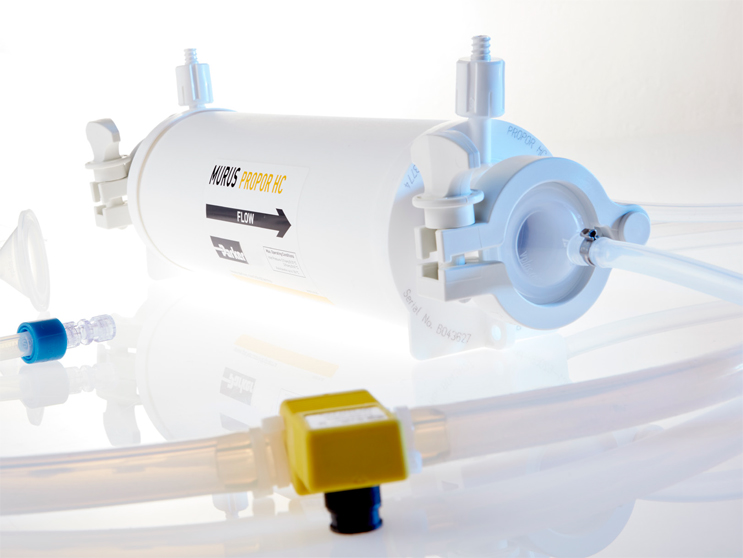
Creating a fully customized single-use assembly, from concept to customer delivery, can take in excess of 16 weeks (and in some cases in excess of 20 weeks) due to hallenges around validation and qualification which create delays in implementation.
Alternatively, generating a configured single-use assembly from a pre-validated design space has advantages in design, component compatibility and lead time.
For instance, at Parker, a single-use assembly created to a customer's design utilizing components from a pre-validated design space can be delivered in a significantly shorter time, and in some instances this can be half that of a fully customized assembly. Here's how it works:
- after the initial concept request, drawings are provided and returned to the customer for approval. As the supply chain route and compliance has already been assessed on these components, the time for design and quotation is significantly reduced.
- during the initial design and quotation, the lead time is assessed in order to be able to create and communicate a reliable delivery schedule to the customer.
- once the drawing is approved, non-irradiated samples (if required) can be supplied with a shorter lead time.
- upon acceptance and order placement, the finished product is manufactured and delivered within the communicated timescales.
- any repeat order not already forecasted and on a delivery schedule would be to the original communicated timescales.
Time reductions and reliable delivery timings are made possible by utilizing a validated 'design space' of components. This lead time is further aided by the localization of manufacturing to sites in both the US (Oxnard, CA) and Europe (County Durham, UK).
Challenge 5: Integrity (leak testing)
Due to the high value of customer products manufactured and processed with single-use technology, the entire single-use assembly must be leak-free and fault-free.
With traditional stainless steel systems, integrity is tested by pressurizing the system and holding at a known pressure for many hours to test for leaks. With single-use assemblies made up from flexible polymeric materials, this type of high pressure hold test is not possible.
The standard test procedures for single-use assemblies are visual inspection and low pressure decay testing. While there may be concern over the level of assurance single-use assembly testing provides, traditional stainless steel systems are also not without risks.
In fact, stainless steel systems could be viewed as having a higher inherent potential risk of leaks when compared to single-use assemblies due to multiple line connections and from the stresses of steam sterilization and temperature fluctuations.
Quality by design (QbD) is a strategy employed to ensure integrity in building single-use systems, not just with the final product. By applying this methodology to the integrity and quality throughout the entire manufacturing process, quality assurance is built in from the start of the manufacturing process.
The single-use assembly manufacturing process starts by identifying areas of risk throughout the entire process, and then continues by developing best practices and procedures to minimize the risks.
Some examples of how Parker builds quality and integrity into the process include:
- selecting raw material and component suppliers carefully to ensure they meet all current biopharmaceutical regulations (such as USP <88> - Biological Reactivity,
- USP <661> - Containers -Plastics) as well as gamma stability and rigorous in-house testing of physical properties
- minimizing risk of assembly damage by manufacturing in a purpose-built ISO Class 7 cleanroom, where furniture and equipment has rounded edges when possible to avoid punctures, and any sharp edges are shielded
- ensuring connectors are robust by clamping to a defined torque setting to ensure they do not leak under validated operating conditions
- performing a final visual inspection and low pressure decay test of assemblies before packing
- shipping assemblies via a validated method - ASTM4169, to ensure they arrive at the customer site undamaged.
How can automated single-use technology improve quality?
Within biopharmaceutical manufacturing, it is often said that the process is the product. Therefore, any variation in the process can impact the finished drug product, potentially causing it to behave differently than was observed in clinical trials. Eliminating process variation improves the overall product quality.
Automation can reduce or eliminate some sources of variation. To fully understand how automation can improve quality, consider these four sources of variation in bioprocesses:
Biological variations result from the use of highly complex living organisms in biopharmaceutical manufacturing. Selecting the right cell line early in the development process is vitally important, but product variability can also be reduced by optimizing process parameters during cell culture.
Raw materials and consumables used in the production of biopharmaceuticals can also be source of variation in the final product. Single-use technology proliferation has introduced greater variability in processing equipment, increasing the importance of single-use suppliers controlling their own supply chain.
Operational inputs cause variation due to differences in the way humans perform. For example, humans can cause variation in how equipment is assembled in-house, in how different teams perform tasks, and in how unit steps are conducted when processes are transferred between facilities. Automation of manual operations can detect and reduce variation within processing parameters.
Environmental variations can result from external contamination and from differences in temperature. Use of a closed system should help control external contamination and automation can add temperature control.
Thus automation helps by increasing process consistency and eliminating variation derived from operational and environmental inputs, while also reducing the opportunity for error and failures. To demonstrate the impact of automating a manual process, consider the case study overleaf.
Case Study
Automated filtration and dispense system achieves payback in one year.
A manufacturer of a potent biologic product approached Parker with a request to automate and enclose a labour-intensive bulk filling process that was highly manual and prone to human error.
The request led to the development of an automated fully enclosed filtration and dispensing system. The resulting system improved product and process safety, simplified the process, reduced labour costs, and reduced the risk associated with transportation of the product.
Several challenges were present, which the customer needed to address:
Challenge 1: The need to divide the product into smaller bottles and bags to allow for easier shipping and minimize the risk of loss of highly valuable product (e.g. damage, leaks) during transportation.
Challenge 2: The lack of a standard process or procedure for sterile filtering and filling meant that there were no standard consumables available within their supply chain and the process needed to be planned far in advance to ensure the consumables were on site and people were trained in the process.
Challenge 3: The need for full containment and automation to minimize the risk of operator exposure to the highly potent product was a key consideration.
The solution
The SciLog® FD System incorporates the ability to dispense a large quantity of product into either bottles or bags connected to a single-use manifold which has been
gamma-irradiated.
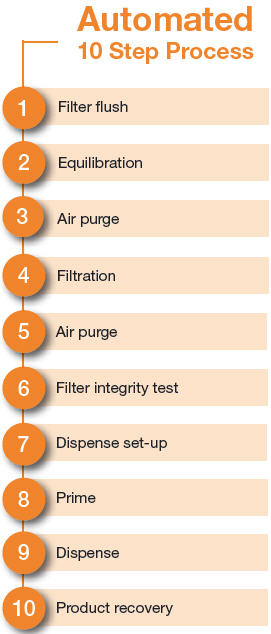
Once filled, the bottles or bags can be disconnected and sealed aseptically, ready for freezing and shipment to the final fill facility. The system automates a 10 step filtration and dispense process (see Figure 2).
The key features of the system are:
- sterility of the final dispensed product achieved by passing the process solution through a sterilizing grade filter
- high accuracy of dispensing solutions and products achieved by a weight-based feedback system
- accurate labelling of containers before removal from the system achieved with an integrated label printer at the point of use
- repeatable and robust procedures based on pre-configured recipes enabled by a PLC-based control system allowing for ease of operation and programming
- systematic error prevention achieved by a bar code system that does not allow the operation to start until the correct manifold and barcode combination is installed.
Based on the outlined case study, automated single-use technology can dramatically reduce two sources of variation.
1. Operational variability is reduced by:
- automating the ten step process
- standardizing the filtration and dispensing operations between operators, batches and campaigns
- increasing the dispensing accuracy.
2. Environmental variability is reduced by:
- eliminating the need for a vertical laminar flow hood
- minimizing the process time ensuring the product is not exposed to temperature fluctuations
- enclosing the system for filtration and dispense of bulk process solutions, thereby protecting both the operator and the process.
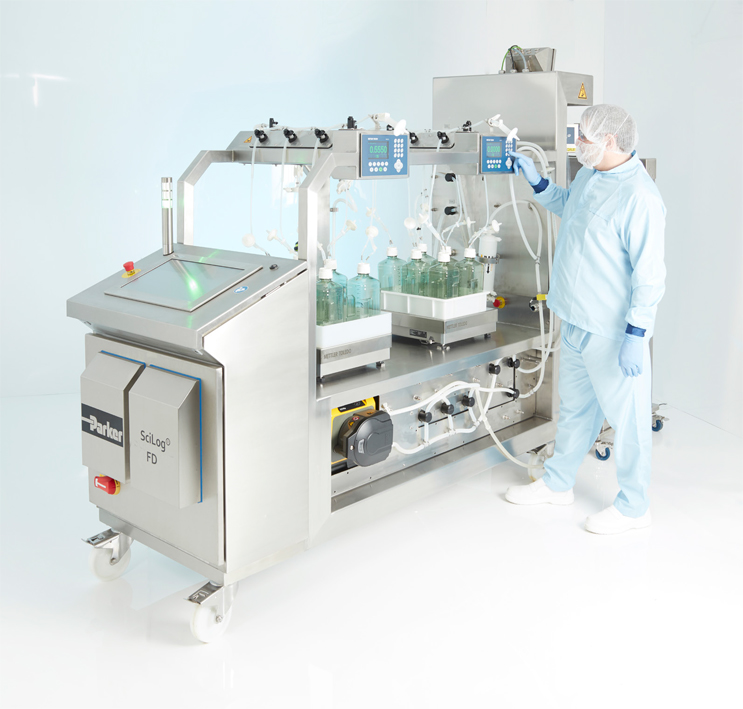
Figure 3: The SciLog® FD System
What's Next?
As the industry focuses on these five challenges to adopting single-use technology.
A number of solutions have been suggested:
- the configured 'design space' approach to single- use manufacturing and componentry can deliver supply chain simplification and speed to market while maintaining product quality and integrity
- automation of single-use bioprocesses can reduce variability and increase productivity
- standardization of operations can be achieved through a combination of solutions, including automation combined with single-use items, which can reduce the need for complex training requirements.
To start creating your single-use solution, visit: www.parker.com/bioscience