
Reimagining Dual-Chamber Injection: De-Risking A Novel Valve Component For Use With Standard Syringe Systems
By Marc Flippe and Sophie Lelias
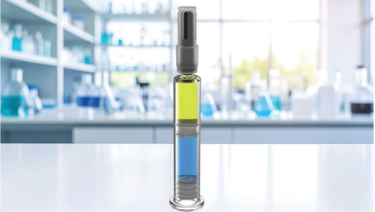
The rise of combination therapies has increased interest in delivering two liquid drugs together without mixing them before use. Dual injection offers an alternative to co‑formulation, avoiding risks associated with chemical interactions, instability, or analytical complexity when two formulations are incompatible. Many existing dual‑injection solutions require specialized containers or device redesigns, adding cost and complexity. To address this, researchers have created a valve that enables dual‑chamber functionality within standard syringe and autoinjector systems, allowing two drugs to remain physically separated until administration.
The design leverages familiar materials and architectures to reduce technical, regulatory and operational risk. Advanced modelling—including finite element analysis, fluid dynamics, seal‑integrity simulation, and autoinjector performance modelling—was used to predict behavior under real conditions, optimize geometry, and ensure reliability across filling, storage, transport, and injection. This approach supports a scalable pathway for developing dual‑injection combination products, enabling efficient integration into existing manufacturing lines and device platforms while maintaining consistent delivery performance.
Get unlimited access to:




Enter your credentials below to log in. Not yet a member of Bioprocess Online? Subscribe today.