
Pfenex Expression Technology® For ncAA-Enabled Site-Specific Conjugation
Non-canonical amino acids enable site-specific modification of therapeutic proteins by introducing a reactive handle at a defined position. Even so, many ncAA programs stall at the development stage. Off-target toxicity, reduced fermentation yields, and the need for reliable incorporation at scale remain key barriers.
Non-canonical amino acids enable site-specific modification of therapeutic proteins by introducing a reactive handle at a defined position. Even so, many ncAA programs stall at the development stage. Off-target toxicity, reduced fermentation yields, and the need for reliable incorporation at scale remain key barriers.
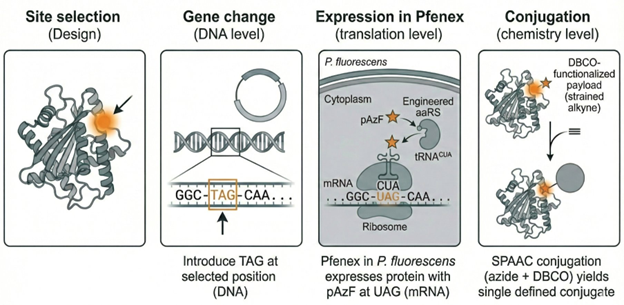
Pfenex Expression Technology® is designed to address those barriers through an integrated development workflow for ncAA-enabled site-specific conjugation. Using an engineered aaRS/tRNA pair for orthogonal amber suppression in Pseudomonas fluorescens, the platform supports rational site selection, high-throughput screening, analytical confirmation, and 2L fermentation optimization. This workflow generates process-relevant data early enough to inform scale-up decisions.
What the capability includes
- Orthogonal aaRS/tRNA amber suppression for site-specific ncAA incorporation
- HDX-MS guided selection of solvent-accessible positions
- 96-well high-throughput screening with automated analytics
- LC/MS confirmation of incorporation at the selected site
- 2L fermentation optimization with controlled pAzF feed strategies
- Post-conjugation functional validation by flow cytometry
- SPAAC conjugation to DBCO-functionalized payloads at the engineered ncAA site
Proof in an anti-GPCR VHH-ADC candidate: PET771
In an anti-GPCR VHH program – PET711 – underway at Primrose, multiple candidate positions were evaluated, and Y84 was advanced for scale-up. Under an optimized continuous pAzF feed strategy at 2L fermentation scale, titers were very similar to the canonical VHH at about 15 g/L. Peptide mapping showed 100% pAzF incorporation. In the case study, intact MS confirmed incorporation at the expected position with no native Tyr or Thr observed. Following SPAAC conjugation, intact MS showed 100% click reaction conversion and binding activity testing showed no significant change in affinity.
This VHH program also highlights why process design matters. Higher pAzF concentrations were shown to be toxic, likely due to off-target amber suppression. Under optimized feeding conditions, however, the system maintained target expression while avoiding observed toxicity to the cells.
Why this matters for candidate selection
By the time a bioconjugate program enters downstream development, key choices such as conjugation site selection, chemistry, and payload strategy are often already locked in and difficult to unwind. That makes it critical to evaluate whether the selected ncAA design, aaRS/tRNA system, and feed strategy can hold up under fermentation conditions, not just in small scale proof-of-concept studies.
Yield, incorporation efficiency, conjugation performance, and post-conjugation function all need to be visible early enough to inform development decisions. Pfenex connects site selection, expression, scale-up, and analytical validation in an integrated development workflow that brings manufacturability into candidate evaluation earlier.
Why Pfenex
Pfenex is built on a Pseudomonas fluorescens based expression platform with six approved products and more than 20 years of experience spanning more than 200 leads and over 500 unique proteins. The Pfenex platform supports integrated ncAA workflows for site-specific ADCs and other engineered proteins, connecting site selection, screening, fermentation, and analytical validation in a development path designated to generate process-relevant evidence.
For teams that need a single defined conjugation site without sacrificing process performance, Pfenex offers a structured path from design through pre-production scale evaluation.