
Permanent Insulin Producing Beta Cell Line Reported by UCSD Scientists
While recent advances in treating diabetics with transplanted pancreas or islet cells, which contain beta cells, have had encouraging results, this approach is limited due to the scarcity of donor tissue from cadavers.
"Even if you had unlimited success with tissue transplantation, there is simply not enough donor tissue to treat the millions of people who have diabetes," said Fred Levine, associate professor at the UCSD Cancer Center and the Whittier Institute in San Diego, whose laboratory reported the successful results. "We have now been able to create an immortal human cell line, and have demonstrated in mice that these cells are functional when transplanted, secreting insulin in response to glucose stimulation."

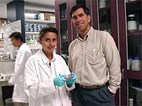
Dominique Dufayet, Ph.D., and Fred Levine, M.D., Ph.D.
Levine and his collaborators, Gillian Beattie and Alberto Hayek at the Whittier Institute, worked out the culture conditions for the beta cells. The cells are grown on a complex three-dimensional extracellular matrix in the presence of hepatocyte growth factor (ref. 1). Once that has been done, retroviral vectors expressing growth stimulatory genes converted the cells into long-term cell lines.
The success of Levine and his San Diego colleagues represents the first demonstration of a functional human beta cell line that secretes insulin in response to glucose stimulation both in culture and when transplanted into mice. In response to a glucose injection, the level of circulating c-peptide in the transplanted mice rose substantially, demonstrating that the transplanted cells were functioning well in the animals. While the level of insulin produced in response to glucose could not be accurately measured, Levine feels that it is approximately the same as in primary islet cells, which would be enough to produce a clinically significant benefit.
Because the same factors that enable their growth and reproduction might also increase the risk of cancer development, the researchers removed the genes that impart replicative potential, thinking that they also might increase their malignant potential. Indeed, mice that received transplants of the cultured beta cells were even less likely to develop tumors than those transplanted with the original parental cell line.
Levine emphasized that further engineering of the cell line is needed to make it more suitable for transplanting into large animals and then, eventually, into humans.
References
- Beattie, GM et al., "Sustained proliferation of PDX-1+ cells derived from human islets," Diabetes, 48(5):1013-9, 1999.
For more information: Fred Levine, Center for Molecular Genetics, Whittier Institute, University of California, San Diego, La Jolla, CA 92093. Email: flevine@ucsd.edu.