
News from ASCB: Snake venom inhibits cell migration
Provides a novel approach for preventing metastases
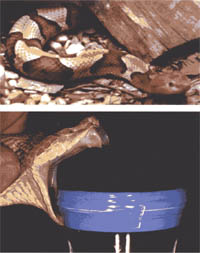 Scientists from the University of Southern California (USC) Keck School of Medicine (Los Angeles) report that the venom from the copperhead snake contains a protein that stops migrating cells in their tracks. Dubbed "contortrostatin," after the Latin name for the southern copperhead, this protein causes cytoskeletal disruptions through inhibition of a complex signal transduction pathway.
Previous research has shown that integrins are required for cells (like metastasizing cancer cells) to move, providing, in effect, the tread that cells use to grip surrounding tissue. Integrins do this through the Src signal transduction pathway, which sends the appropriate signals to the cytoskeleton and cellular motors. Contortrostatin acts on these pathways, according to USC researchers Francis Marland, Matthew Ritter, and Qing Zhou.
Marlkand and his co-workers found that contortrostatin, a homodimeric, RGD-containing disintegrin, binds the avb3 integrin, dramatically increasing tyrosine phosphorylation of FAK and CAS in tumor cells. Treating tumor cells with the Src family kinase inhibitor PP1 completely abrogates contortrostatin-induced tyrosine phosphorylation, implicating these kinases in the pathway modulated by contortrostatin. The end result is the collapse of the cytoskeleton, which in turn removes the cell's ability to move.
In other studies, the authors found that contortrostatin hinders the growth and metastasis of several different human tumors implanted in mice. Not only does the snake protein thwart the spread of new tumors throughout the body, but it also stops the growth of existing tumors by inhibiting the formation of blood vessels that feed them. This double-forked action may make the venom protein a potent treatment for cancer in the future.
For more information: Francis S. Markland, Biochemistry and Molecular Biology, University of Southern California Keck School of Medicine, 1303 N. Mission Rd., CRL 106, Los Angeles, CA 90033. Tel: 323-224-7981. Email: markland@hsc.usc.edu.
Edited by Laura DeFrancesco
Managing Editor, Bioresearch Online
ldefrancesco@vertical.net
Click here for more research and product news from the ASCB Annual Meeting.