
New Research Could Give "Green Light" To Biotech Advancement
By Lori Clapper
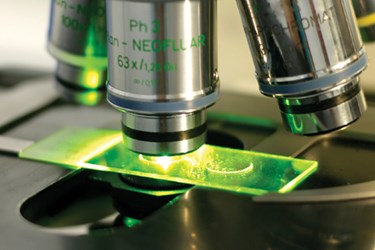
Scientist say they are close to unraveling the mystery behind fluorescent green light that is naturally produced by certain animals. This light could be useful in advancing the biotechnology field, according to a study published in the Scientific Reports.
More specifically, the U.S. Air Force and the Department of Defense could significantly benefit from the research because they use many different biosensors in biomedicine, bioengineering, and materials science. These proteins that provide very bright light will help expand technology research because of the high signal-to-noise ratio, researchers from the University of California, San Diego told Nature World News. This light can be used in the field of biotechnology to track gene expression throughout the body and for biomedical protein tracers.
"We discovered that some of the amphioxus GFPs are able to transform blue light into green light with 100 percent efficiency, which combines with other properties of light absorbance to make the amphioxus GFPs about five times brighter than current commercially available GFPs, resulting in effect to a huge difference," lead author Dimitri Deheyn explained. "It is also interesting that the same animal will also express similar GFPs with an efficiency of about 1,000 times less."
The fish-shaped marine invertebrates that produce this natural glow are also known as "amphioxus." These creatures emit very bright and dimmer versions of their light green fluorescent glow, which is created from the transformation of blue excitation light into green emission light.
Studies have shown the amphioxus GPSs can accomplish light transformation with 100 percent efficiency, making the amphioxus GFPs five times brighter than currently engineered GFPs that only reach 60 to 80 percent efficiencies. This discovery paves the way for great increases in biotechnology efficiency.
Deheyn and his colleagues have researched structural difference of the GFPs, which they have found is the stiffness around the animal’s chromophore pocket or the area of proteins responsible for molecular transformation of light. However, they have yet to find out what exact mechanism controls this ability. But he adds that this discovery “opens the door towards understanding.”