
New Research: Co-Expression Could Make Plant-Based Systems Viable
A conversation with Julia Solonenka, Queensland University of Technology
The high cost of Protein A resins remains a significant bottleneck in downstream processing for the biopharmaceutical industry. Co-expression with the protein of interest presents a powerful alternative that could obviate an essential but hefty budget item.
Julia Solonenka, a Ph.D. candidate in plant biotechnology at the Queensland University of Technology, is tackling this challenge by reimagining the role of the expression host. Her research focuses on utilizing Nicotiana benthamiana to co-express target antibodies alongside Protein A fused to elastin-like polypeptides (ELPs).
By leveraging the unique inverse temperature transition properties of ELPs, Solonenka’s work aims to replace traditional expensive chromatography with a non-chromatographic "one-pot" system. This method cycles the protein extract between soluble and insoluble states, allowing for the rapid elimination of contaminants. Furthermore, her team is exploring innovative secondary protein expression platforms by engineering the Agrobacterium already present in the plant leaves to further streamline production.
Building on recent advancements in molecular engineering, the research aims to close the gap between plant-based expression and industrial scalability. Solonenka offered to give us an overview of her work and answer some specific questions about the mechanics of ELP tuning, the metabolic costs of plant-based production, and the future of low-cost recombinant protein recovery.
Protein A and resin beads are expensive. Your research shows how protein A performs a different function and can be co-expressed using N. benthamiana. Can you give us an overview of what happens in the plant?
Solonenka: In our process, we transiently express the protein of interest in N. benthamiana by physically infiltrating the interstitial leaf spaces of the plant with Agrobacterium tumefaciens, a bacterium that naturally causes crown gall disease. In this mediated transformation, DNA is transferred from the tumor-inducing plasmid in the Agrobacterium, and a region of transfer-DNA (T-DNA) from these plasmids is integrated into the plant nuclear genome. By including our gene of interest on the T-DNA, we can hijack the plant’s machinery to express our desired protein in the infected leaf cells.1 After approximately five to 10 days, the infiltrated leaf material is collected and homogenized in buffer to break open the plant cells and release the soluble protein.
Plant-based recombinant expression systems are readily and cheaply scalable, but the plant matrix is more complicated than in other traditional expression hosts, so current downstream processing costs are high. By co-expressing our antibody of interest and the Protein A fused to a secondary enrichment tag, we aimed to simplify the purification process into a one-pot system by having both entities present in the plant homogenate.
Is there a metabolic cost to the plant when producing a larger hook, protein A, in tandem with the protein of interest?
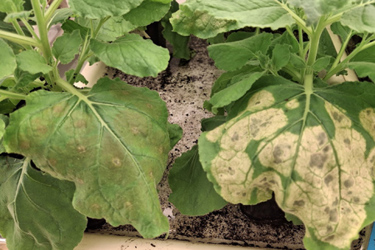
Solonenka: We’ve noticed an upper limit for transiently expressing certain proteins in plants, which we think could be a result of heightened endoplasmic reticulum (ER) stress. This usually manifests as necrotic patches in the infiltrated leaves (as shown in the photo above), and/or stunted leaf expansion, both of which substantially lower protein titers. In our case, unfused Protein A appeared to be preferentially produced versus the antibody when the constructs were both co-expressed in N. benthamiana, and the metabolic stress in the plants was visually apparent within a few days after infiltration.
To reduce the burden on the plants, we are taking a couple of different approaches. For one, we’re using an ELP fusion tag, which helps keep the protein soluble and properly folded while also acting as the purification tag in the downstream process. In our second approach, we are developing a method in which we exploit the Agrobacterium still colonized in the leaves as a secondary protein expression platform to produce the Protein A, while the plant is used solely to generate the desired antibody. Our laboratory recently developed new molecular methods for engineering Agrobacterium2, so we are hoping to demonstrate a possible use case for this new toolbox.
How does the inverse temperature transition of ELPs facilitate a non-chromatographic workflow?
Solonenka: ELPs are a class of polypeptides composed of repeating pentapeptide motifs (Val-Pro-Gly-Xaa-Gly (VPGXG), where the fourth “guest” residue Xaa can consist of any amino acid except for proline) that are capable of inverse temperature transition; below their specific transition temperature (Tt) they are soluble in aqueous solution, but above the Tt they rapidly aggregate, precipitating out of solution. Inverse transition cycling (ITC) involves subsequently cooling and warming the protein extract above and below the ELP’s Tt to cycle between its soluble and insoluble states, rapidly eliminating contaminants with each step. The aggregated ELPs are typically retrieved by centrifugation, although they can be recovered by filtration as well. Since the tag is self-interactive, traditional chromatography is not involved in the workflow.
Your research mentions using 4 M NaCl to trigger transition. At a commercial scale, does disposing of spent buffer become a waste-stream issue? Have you tested ELP variants that transition with lower salt or just heat alone?
Solonenka: The transition temperature of an ELP is dependent on many factors: the ELP composition (length and guest residues) and concentration, the hydrophobicity of the fusion partner, osmolyte concentration, and ionic strength, to name a few. Sodium chloride is initially applied at the lab scale to decrease the transition temperature because it’s benign, inexpensive, and almost always works. But there are several ways that ELPs can be tuned to transition under milder conditions for industrial use.
One common ELP composition, colloquially known as the 100xELP, has a specific ratio of alanines, valines, and glycines in its guest residue positions, which were specifically adjusted for it to transition around 40 degrees C, slightly above the incubation temperature of E. coli.3
An important consideration when designing the ELP is that, generally, the properties that make it easier to recover also make the protein more difficult for the host organism to express.
Therefore, balancing an ELP sequence between efficient expression and purification is a critical step of the process. Currently, we are testing a cationic ELP variant that is expected to require less salt to aggregate compared to a neutral ELP, which was proposed as an alternative way to circumvent some of these expression challenges while maintaining high purification efficiency.4
A current challenge in the industry is obtaining the physical DNA sequences for ELPs. Cloning them in-house usually involves a tedious method called recursive directional ligation, which involves stitching the pentapeptides together block-by-block with each ligation step.5 Otherwise, in an era where whole genes can be synthesized for under $70 U.S., a single full-length ELP sequence can still cost upward of $5,000 U.S. according to the most recent quotes we’ve received. Once the technology advances and this bottleneck is addressed, it will be possible to engineer highly specific ELPs, allowing us to screen for more optimal expression and purification profiles. As soon as high-throughput screening of ELP-fusion constructs is made feasible, I anticipate there will be a greater uptake in the industrial use of these proteins.

This model potentially trades one complex and expensive step for another when the co-expressed tag and antibody of interest aggregate and fall out of solution. When that happens, does separating them reverse any savings if you need pricey denaturants and refolding steps? What controls prevent insolubility and maintain reversible aggregation?
Solonenka: In this step, only the ELP transitions into the aggregated state, while the Protein A and the intermolecularly bound antibodies remain correctly folded and fully functional. Any irreversible aggregation we’ve observed has been the result of the proteins denaturing in response to overheating, which can occur if the ELP concentration is too low to aggregate under any reasonable conditions. Under the right conditions, ITC does not impact the folding or activity of the fusion partner or other proteins being purified; in our assessment of 16 studies reporting on the activity of plant-produced ELP fusion proteins published since 2004, all of them retained activity after purification. As well, Protein A-, Protein L-, and Protein G-ELPs have been shown to readily purify antibodies without any detriment, based on many previous demonstrations.6,7,8,9
Standard chromatography is expensive, but it's also effective. How do one-pot purification yields compare?
Solonenka: The constructs for plant-based production of Protein A-ELPs are still under development, but as for our Agrobacterium construct, our initial analysis demonstrated that we could recover approximately 40 mg/L bacterial culture of >95% pure Protein A-ELP using ITC. In contrast, only about 10% of this amount was recovered using a Streptavidin-based purification.
While Protein A can be produced at scale in g/L amounts in other systems, Agrobacterium has not been used for recombinant production on its own before, and we’re using the same competent strain as we do for mediated transformation in our proof of concept. In this sense, it’s similar to trying to use something like TOP10 E. coli as a production strain. We don’t have any capacity to engineer the strains ourselves, so we’re aiming to increase recovery from the bacteria in the plants by further optimizing the infiltration and harvest process.
What's next? Are you looking for ways to scale this technology for industrial use?
Solonenka: Initially, we planned to develop a competent Agrobacterium strain with Protein A-ELP production as an enabling tool for researchers to cheaply recover and assess different antibody constructs in plants. While this is still the intention of the one-pot purification scheme, we are also exploring the capacity of our N. benthamiana platform to produce Protein A-ELP fusions at scale, which has the greater potential for industrial use. We will be testing these different strategies with some biologics that we are developing for our industry partners, International Animal Health Products, in the upcoming months.
References:
- Gelvin, S. B. (2003). Agrobacterium-mediated plant transformation: the biology behind the "gene-jockeying" tool. Microbiol Mol Biol Rev, 67(1), 16-37, table of contents. https://doi.org/10.1128/mmbr.67.1.16-37.2003
- Holdsworth, W., LeBlanc, Z., Moddejongen, S., Moffitt, K., Theodoropoulos, C., Speight, R. E., Waterhouse, P., Sainsbury, F., & Behrendorff, J. B. (2025). Monitoring and orthogonal control of agrobacteria in Nicotiana benthamiana leaves. Plant Biotechnology Journal, n/a(n/a). https://doi.org/https://doi.org/10.1111/pbi.70056
- Meyer, D. E., & Chilkoti, A. (1999). Purification of recombinant proteins by fusion with thermally-responsive polypeptides. Nature Biotechnology, 17(11), 1112-1115. https://doi.org/10.1038/15100
- Conley, A. J., Joensuu, J. J., Jevnikar, A. M., Menassa, R., & Brandle, J. E. (2009). Optimization of Elastin-Like Polypeptide Fusions for Expression and Purification of Recombinant Proteins in Plants. Biotechnology and Bioengineering, 103(3), 562-573. https://doi.org/10.1002/bit.22278
- McDaniel, J. R., MacKay, J. A., Quiroz, F. G., & Chilkoti, A. (2010). Recursive Directional Ligation by Plasmid Reconstruction Allows Rapid and Seamless Cloning of Oligomeric Genes. Biomacromolecules, 11(4), 944-952. https://doi.org/10.1021/bm901387t
- Kim, J. Y., Mulchandani, A., & Chen, W. (2005). Temperature-triggered purification of antibodies. Biotechnology and Bioengineering, 90(3), 373-379. https://doi.org/10.1002/bit.20451
- Sheth, R. D., Bhut, B. V., Jin, M., Li, Z., Chen, W., & Cramer, S. M. (2014). Development of an ELP-Z based mAb affinity precipitation process using scaled-down filtration techniques. Journal of Biotechnology, 192, 11-19. https://doi.org/10.1016/j.jbiotec.2014.09.020
- Shimazu, M., Mulchandani, A., & Chen, W. (2003). Thermally triggered purification and immobilization of elastin-OPH fusions. Biotechnology and Bioengineering, 81(1), 74-79. https://doi.org/10.1002/bit.10446
- Swartz, A. R., Xu, X. K., Traylor, S. J., Li, Z. J., & Chen, W. (2018). One-step affinity capture and precipitation for improved purification of an industrial monoclonal antibody using Z-ELP functionalized nanocages. Biotechnology and Bioengineering, 115(2), 423-432. https://doi.org/10.1002/bit.26467
- Conley, A. J., Joensuu, J. J., Jevnikar, A. M., Menassa, R., & Brandle, J. E. (2009). Optimization of Elastin-Like Polypeptide Fusions for Expression and Purification of Recombinant Proteins in Plants. Biotechnology and Bioengineering, 103(3), 562-573. https://doi.org/10.1002/bit.22278
- Gelvin, S. B. (2003). Agrobacterium-mediated plant transformation: the biology behind the "gene-jockeying" tool. Microbiol Mol Biol Rev, 67(1), 16-37, table of contents. https://doi.org/10.1128/mmbr.67.1.16-37.2003
- Holdsworth, W., LeBlanc, Z., Moddejongen, S., Moffitt, K., Theodoropoulos, C., Speight, R. E., Waterhouse, P., Sainsbury, F., & Behrendorff, J. B. (2025). Monitoring and orthogonal control of agrobacteria in Nicotiana benthamiana leaves. Plant Biotechnology Journal, n/a(n/a). https://doi.org/https://doi.org/10.1111/pbi.70056
- Kim, J. Y., Mulchandani, A., & Chen, W. (2005). Temperature-triggered purification of antibodies. Biotechnology and Bioengineering, 90(3), 373-379. https://doi.org/10.1002/bit.20451
- McDaniel, J. R., MacKay, J. A., Quiroz, F. G., & Chilkoti, A. (2010). Recursive Directional Ligation by Plasmid Reconstruction Allows Rapid and Seamless Cloning of Oligomeric Genes. Biomacromolecules, 11(4), 944-952. https://doi.org/10.1021/bm901387t
- Meyer, D. E., & Chilkoti, A. (1999). Purification of recombinant proteins by fusion with thermally-responsive polypeptides. Nature Biotechnology, 17(11), 1112-1115. https://doi.org/10.1038/15100
- Sheth, R. D., Bhut, B. V., Jin, M., Li, Z., Chen, W., & Cramer, S. M. (2014). Development of an ELP-Z based mAb affinity precipitation process using scaled-down filtration techniques. Journal of Biotechnology, 192, 11-19. https://doi.org/10.1016/j.jbiotec.2014.09.020
- Shimazu, M., Mulchandani, A., & Chen, W. (2003). Thermally triggered purification and immobilization of elastin OPH fusions. Biotechnology and Bioengineering, 81(1), 74-79. https://doi.org/10.1002/bit.10446
- Swartz, A. R., Xu, X. K., Traylor, S. J., Li, Z. J., & Chen, W. (2018). One-step affinity capture and precipitation for improved purification of an industrial monoclonal antibody using Z-ELP functionalized nanocages. Biotechnology and Bioengineering, 115(2), 423-432. https://doi.org/10.1002/bit.26467
About The Expert:
 Julia Solonenka is a current Ph.D. candidate in plant biotechnology at the Queensland University of Technology. Her doctoral research is focused on the development of economical methods for purifying recombinant proteins in N. benthamiana. Previously, she completed a M.Sc. in analytical chemistry at the University of British Columbia, characterizing non-protein amino acids in plants and cyanobacteria, and a B.Sc. in medicinal chemistry from the University of Waterloo.