
New Alzheimer Target Discovered
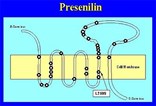
Presenilin 1 has long been associated with Alzheimer's; mutations in presenilins result in the creation of especially toxic forms of the amyloid precursor protein (APP) fragment—the proteolytic product that precipitates in the brain, causing the plaques that are characteristic of Alzheimer's patients. These mutations were accompanied by changes in g-secretase activity, which cleaves at a different site on the protein resulting in a longer and more toxic peptide. However, it was not known whether preselinin was directly involved with the cleavage of the APP protein, or somehow facilitated either the cleavage or precipitation of the fragment.
Now, the group from Merck has evidence that presenilin is in fact g-secretase, as they found that inhibitors of g-secretase bind to preselinin 1. Using transition-state analog inhibitors designed to interact with the active site of an aspartyl protease, they demonstrated binding to presenilin 1. Interestingly, presenilin itself appears to require processing of some kind to become active as a protease. The inhibitor didn't bind to native presenilin, apparently because it lacked the active site conformation required for binding.

Dennis Selkoe, a neurobiologist on the Harvard team, said the finding still must be confirmed. But it provides drug companies a potential target to create drugs that block the action of the enzyme.
"This is not just pie-in-the-sky," Selkoe said. "There is a palpable sense that knowing what g-secretase is, we should be able to inhibit it."
"The significance of the work we described in our paper is it helps better define the target for possible therapeutic agents in Alzheimer's disease," said Steve Gardell, director of biological chemistry for Merck. "We are in the early stages of this drug development campaign."
For more information: Stephen Gardell, Department of Biological Chemistry, Merck Research Laboratories, West Point, PA 19486. Tel: 215-652-5000. Fax: 215-652-5222.