
Magnetic Fields Can Deter Malaria
Malaria is spread by female anopheles mosquitoes harboring single-celled parasites. The parasite first invades the liver and then migrates to the bloodstream, where it attacks red blood cells. Inside the red blood cells, the malarial parasites degrade hemoglobin, and use the digested globin protein portion as food. However, they lack an enzyme to break down the iron-containing heme portion. Because free heme is toxic to the parasites, they neutralize it by linking it together to form a chain called hemozoin, which inactivates most or all of the individual particles.
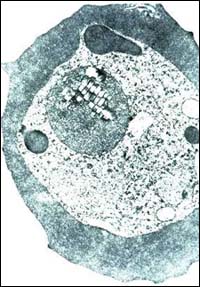
A malaria parasite within a human red blood cell. The large circle in the parasite is a food vacuole. Stacked heme are visible inside the vacuole.
"It's a very clever way to do it," said Henry Lai, a professor of bioengineering at the University of Washington, who is also involved with the project.
But the Seattle scientists are hoping to turn this molecule into a liability for the parasite. Recognizing that stacking heme, which has iron at its center, creates in effect a magnet, the researchers are applying low-level magnetic fields to shake and disrupt the hemozoin. The wobbling hemozoin can also prevent the parasite from neutralizing more iron particles, he said, causing a buildup of free heme that progressively poisons the parasite as it feeds.
In initial studies, they added Plasmodium falciparum parasites to red blood cells in culture dishes, placing some within a low-level magnetic field and others outside the field. After two days, the researchers found that the number of parasites within the magnetic field had 33 to 70% fewer parasites than unexposed samples. Measurements of hypoxanthine, a precursor for nucleic acid synthesis used by the parasite, indicated that metabolic activities had also significantly slowed in exposed samples. Such reductions would be enough to manage malaria, Lai said.
Past efforts to control malaria relied heavily on the drug chloroquine, which prevents the parasite from converting the toxic heme into harmless hemozoin. But about 40 years ago, some malarial strains began gaining resistance to the drug. Now, in some parts of Southeast Asia and Africa, chloroquine has no effect, creating a crisis that is beginning to engulf neighboring regions as well.
Researchers say the direct physical force of low-level magnetic fields, similar to those encountered in the natural environment, may be much harder for the parasites to overcome than the indirect chemical force of chloroquine.
If the technique pans out, Lai said, the magnetic field could boost the effectiveness of anti-malarial drug therapy or even take its place in drug-resistant areas, perhaps in the form of hospital rooms or transport trucks equipped with magnetic coils on the floors and ceilings.
Dan Goldberg, a professor of medicine at the Howard Hughes Medical Institute at Washington University in St. Louis, characterized the Seattle researchers' effort as "a unique approach to a critically important issue." But before the creative idea can move off the drawing board, he said, researchers must further refine the technique and address safety issues associated with human exposure to magnetic fields.
For more information: Henry Lai, University of Washington, Department of Bioengineering, Seattle, WA 98195. Tel: 206-543-1071. Email: hlai@u.washington.edu.