
Isis Talks to Analysts at 'Biotechnology Field Trip'
Contents
Introduction
Genetrove and Ibis: New Targets, New Approaches
Success Breeds Uncertainty
Products and Development
Introduction (Back to Top)
OK, the 100,000-gene human genome is almost sequenced and scientists estimate that 10% of those genes could be targets for new therapeutic agents. Now what? Even if one considers only antisense drugs, then 10,000 DNA sequences plus 10,000 RNA sequences, and a nearly infinite number of binding sites (assuming contiguous 5- to 15-base sequence fragments) means we've only just begun to tap into the genomic treasure trove.
During a presentation at the CS First Boston West Coast Biotechnology Field Trip in Los Angeles last Friday, Isis Pharmaceuticals Inc. (Carlsbad, CA) chairman and CEO Stanley T. Crooke highlighted the central role his company's technology plays in functional genomics, in particular as it applies to drug discovery.

Isis CEO Stanley T. Crooke called his firm's approach to RNA antisense "rational, specific, universal."
From its inception, Isis has focused on what is generally accepted as a "new" drug discovery target, RNA. The recent discovery that some antibiotics work by inhibiting bacterial RNA, however, indicates that nature also targets RNA. As Crooke stated in his presentation, "Nature has validated our RNA antisense approach. We've pioneered in antisense and have created the first commercial antisense product and an exciting pipeline of product opportunities. In the process of doing that we've also created an exceptionally useful tool for genomic-based drug discovery."
Genetrove and Ibis: New Targets, New Approaches (Back to Top)
Isis's new GeneTrove effort uses antisense technology to determine which genes are the best targets for drug discovery by answering key questions about genes: what they do, how they behave within cells and biological systems, whether they are important in disease, whether they would make good drug targets. That information, GeneTrove's product to pharmaceutical and biotech companies, represents an important revenue opportunity for Isis.
"Antisense is exciting because it's rational. Since it uses small molecules to bind to linear regions of RNA it's also specific for those sequences on those particular genes. Because of this specificity antisense can be viewed as a set of 'molecular tweezers' that tell us exactly what a gene does. Of course specificity means there is the potential to make much more effective drugs. And finally, antisense is universal. We now know that we can create an antisense inhibitor of any gene at any time we care to."
GeneTrove is already engaged in genomics collaborations with three major pharmaceutical industry partners: Abbott Laboratories, Aventis, and AstraZeneca, and hopes to add new partners this year. The sequencing of the human genome will require the pharmaceutical industry to make crucial drug discovery decisions, namely which genes are appropriate targets for research efforts. GeneTrove has created and integrated proprietary systems that facilitate and inform these decisions very rapidly and efficiently. These processes are fundamental to Isis' core antisense research in identifying antisense drug candidates and support Isis unique proficiency in functional genomics.
In addition, GeneTrove's competitive position is strengthened by Isis' strong antisense patent estate, and the Human RNase H patent in particular. Human RNase H1 is a cellular enzyme that degrades RNA when antisense inhibitors bind to RNA. Most antisense inhibitors work through this mechanism of action. This patent covers most antisense drugs in clinical trials as well as most methods of identifying antisense inhibitors as drugs and as genomics tools for gene functionalization and target validation. Isis hopes to generate meaningful revenues from the licensing of this patent in the near future.
"Our genomics products and our RNase H patent represent important, immediate products for Isis, each with the potential to add considerable revenue in the near term," Crooke said during his talk with analysts. "In GeneTrove, we offer valuable products to the pharmceutical and biotech industries at a crucial time in the genomics revolution when competitive advantages in discovery and development can be realized through rapid access to high quality functional genomics information. GeneTrove answers the most challenging of drug discovery questions rapidly and efficiently. Already, GeneTrove has created inhibitors to hundreds of genes, validated multiple targets and dissected numerous disease pathways."
Crooke explained how GeneTrove's genomics and antisense programs, with Isis's Ibis initiative, are three key "value drivers" for the company, as its genomics and Ibis programs are now sufficiently mature to contribute near-term value.
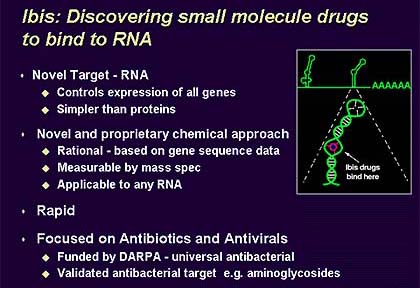
Isis'newest offering is its Ibis technology platform, which has near-term potential to add value through innovative drug discovery partnerships. Ibis has pioneered a new approach to identify structured regions of RNA to serve as targets for small molecule drugs. Ibis integrates functional genomics, advanced informatics, computational chemistry, combinatorial organic synthesis, automation, mass spectrometry-based screening, and HTS functional assays into a comprehensive discovery effort exclusively focused on RNA.
"Our antisense program continues to evolve," Crook said. "GeneTrove and Ibis are now mature enough that they add substantial value to our company."
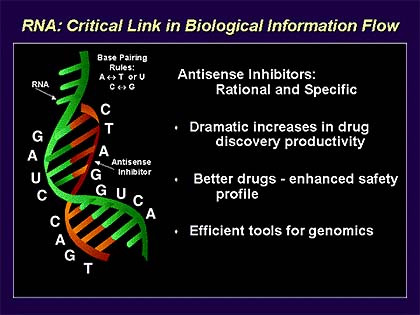
Isis capitalizes on transcription of DNA to messenger RNA. Traditional drugs hit proteins involved in disease whereas Isis's targets are messenger RNA, one step upward in the gene-to-disease chain.
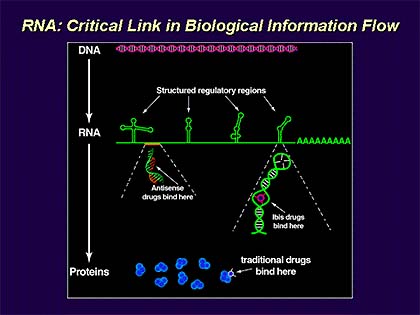
RNA consists of both linear regions (which resemble and act like genes) and structured regions (see figure immediately above) that help the cell determine where the RNA should go and what it should do. Linear region targets are handled with antisense. Isis's Ibis program targets structured regions, whose irregular geometries jut out from the landscape of an RNA strand like strange-looking buildings on a horizon, with small molecule drugs.
Success Breeds Uncertainty (Back to Top)
Successes in gene sequencing offer discovery scientists an unusual opportunity. Although only 10% or so of all genes are potential drug discovery targets, the size and sequences of genes represent a nearly infinite number of concrete binding targets. "For the first time in history the number of possible targets outstrips the available resources to exploit them. So determining which genes to work on is crucial. What's even more crucial is realizing the resources needed to exploit even one opportunity, since it may involve 40 or 50 people working for four to five years"
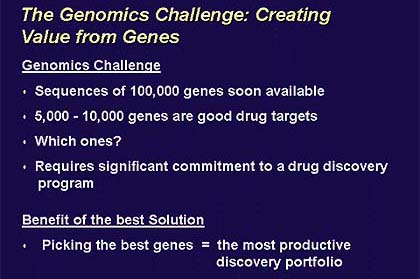
Isis participates in drug discovery at every step beyond gene sequencing. Crooke added, "We don't sequence genes, but through antisense we determine what genes do, where they do it, if they're good targets for drug discovery (target validation), and develop pipeline-stage drugs for acceptable targets."
To allocate resources intelligently, Crooke suggests answering these questions:
- What does a gene do? (gene characterization)
- How is the gene regulated? (gene functionalization)
- Is it a good target? (gene validation)
"Through GeneTrove, Isis can answer these questions quickly and efficiently. If someone gives us a gene, in the space of a couple of hours the computer will design antisense inhibitors to different sites in the RNA. Those inhibitors are quickly screened to find the best sites on the RNA, and that compound is then ready for animal models. So within one to two weeks we can have an inhibitor ready for study. Very rapid, very universal."
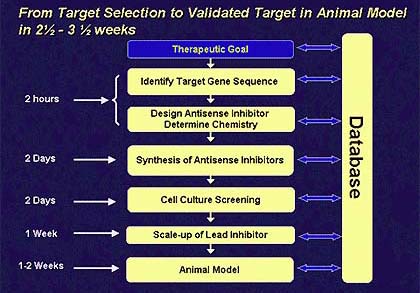
Not satisfied with the specificity and universality of antisense, Isis focuses on methods that also make it extremely rapid.
Crooke gave as an example a hepatitis discovery program. "Let's say you're interested in a research program for treating hepatitis, a disease that can be caused chemically or by viruses. At the end of the day both bring about liver cell death through complex pathways involving various genes." The question for the head of research is which genes to focus on. What an Isis scientist did was simply create a panel of antisense inhibitors to every gene in the pathways identified. After an initial screen the best inhibitors were fed to mice to verify that the right genes were inhibited. Next, the compounds were tested in diseased animals and several were found to protect animals from death. The entire process took a single scientist a couple of weeks.
Products and Development (Back to Top)
Isis's first product, Vitravene (fomivirsen), for treating CMV-induced retinitis in AIDS patients, is sold in the United States, Europe, Brazil, and Switzerland. Isis has five drugs in Phase II clinical trials, at least one of which is expected to advance to Phase III this year. Lead products include ISIS 3521 in non-small cell lung cancer and non-Hodgkin's lymphoma, ISIS 2302 in a topical cream formulation for psoriasis, and ISIS 14803 for Hepatitis C.
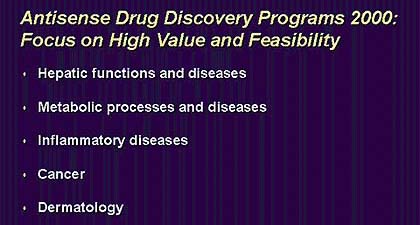
Other drugs progressing through clinical trials include molecules for inflammatory diseases, multiple sclerosis, and additional cancer tumor types. Isis' antisense research program is focused on additional areas including liver disease, diabetes and dermatology. The company also has several additional compounds in preclinical development. Isis' broad and proprietary patent estate of over 600 issued and allowed patents worldwide and has been recognized as one of the top ten holdings of gene patents issued in the U.S.
For more information: Karen Lundstedt, Executive Director, Isis Pharmaceuticals Inc., Carlsbad Research Center, 2292 Faraday Ave., Carlsbad, CA 92008. Tel: 760-603-3880.
By Angelo DePalma