
Homogeneous Assay Technology
BioSignal recently introduced AlphaScreen (Amplified Luminescent Proximity Homogeneous Assay), a non-radioactive, proximity based homogeneous assay technology. It has been developed to provide true, robust miniaturization for a broad range of applications.
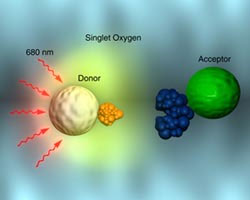
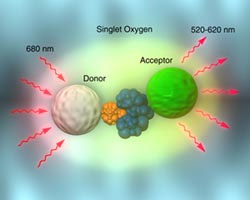
AlphaScreen assays are based on the photochemical interaction of two types of beads, each conjugated to a biomolecule that is specific to the assay being performed. The first bead (donor) absorbs red light and generates singlet oxygen molecules (see figure 1). The singlet oxygen molecules are only absorbed by the second bead (acceptor) if it is in close proximity to the donor bead (see figure 2). Upon absorbing the singlet oxygen, the acceptor bead emits light at a lower wavelength for an extended period of time. This permits the use of time-resolved counting technology, which eliminates artifacts due to sample and plate background.
The AlphaQuest HTS Microplate Analyzer is designed for use with AlphaScreen technology in HTS applications. It is a four detector system that uses high efficiency laser diode excitation, remote optics and photomultiplier tubes to measure the fluoresence generated by the acceptor bead. The AlphaQuest can either be used with its 40 plate stackers or can be integrated in a screening system.
A variety of AlphaScreen assays have been rapidly developed and optimized for HTS in micro-volume formats (5-20 µl), these include the following: whole cell cAMP assay, c-Src Kinase assay, protein/DNA interaction assays, protein-protein interaction assays, helicase assay, MAP kinase assay, Gb-GIRK1 interaction assay, cathepsin D Protease assay, TNF binding assay, immuno assays.
Packard Instrument Company, 800 Research Parkway, Meriden, CT 06450, phone: 800-323-1891 Fax: (203) 639-2172