
Halophile genome sequence completed
Halobacterium NRC-1 is a member of the archaea, the third branch of life in the biological world. Archaea, which are considered evolutionary relics, grow best in an environment 10 times saltier than seawater, yet they represent a third of all living creatures. Astronomical numbers of Halobacteria—a microscopic, rod-shaped organism—can be found in bodies of very salty water, including the Great Salt Lake and the Dead Sea.
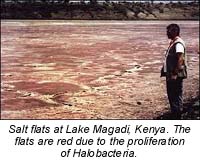 The single-celled organisms use sunlight to synthesize energy, giving off a red byproduct that has been harvested for commercial use for its light-sensitive properties. When a body of water turns bright pink or red, it is often a sign that millions of Halobacteria are present. These microorganisms, and their red pigment, can remain in salt crystals left behind long after a lake dries up.
The researchers sequenced the 2.5 million base pair bacterial genome using a "shotgun" technique, and found more than 2,500 putative genes, about a third of which are novel and have never previously been reported.
"Genome studies on Halobacterium should contribute toward some of the greatest unsolved mysteries of biology today, including our understanding of evolution as well as of the fundamental life process in higher cells," says DasSarma. "There is a tremendous genetic resource in the genomes of microorganisms. In fact, it is one of the last, largely untapped natural resources on our planet."
DasSarma adds, "These tiny creatures will provide many insights into how more complex creatures manage life functions, including cell division, and the way cells transport proteins across biological membranes. Right now, several biomedical applications using Halobacterium are being investigated, including the development of orally administered vaccines, and the design of new antibiotics."
For more information: Shiladitya DasSarma, Department of Microbiology, University of Massachusetts, Amherst, MA 01003. Tel: 413-545-2581. Email: dassarma@microbio.umass.edu.
Edited by Laura DeFrancesco
Managing Editor, Bioresearch Online
ldefrancesco@bioresearchonline.com