
Golgi apparatus comes of age
Yale scientists find Golgi independent of endoplasmic reticulum
Researchers at Yale University (New Haven, CT) report that, contrary to previous beliefs, the Golgi apparatus is not an outgrowth of the endoplasmic reticulum, but has an identity and an existence of its own. Published in the October 26 issue of Nature, the discovery gives researchers a better understanding of the dynamics of cell division and of the processes required to maintain and replicate this subcellular organelle.
"Researchers once thought that the Golgi apparatus was no more than an outgrowth of an organelle called the endoplasmic reticulum," said Graham Warren, professor of cell biology at Yale and a lead author of the study. "We've shown that it is an organelle within a cell that has its own autonomy and so must grow and divide to keep pace with the growth and division of the cell it inhabits."

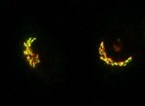
Fluorescence picture of the Golgi apparatus. NRK cells were stained with antibodies to the Golgi enzyme GalT (galactosyltransferase) in green and for the Golgi Matrix protein GM130 in red.
The Golgi apparatus is normally thought of as a stack of membrane compartments through which the secretory proteins pass, but Warren and colleagues showed that the Golgi has an existence even when these membranes are removed from the apparatus.
"We found that there are proteins, which we term matrix proteins, that form a scaffold to organize the membranes," said Warren. "We think this scaffold might be the Golgi apparatus proper, responsible for its growth, division, and partitioning between the two daughter cells."
In past research, Warren and his team have shown that the regrowth of a mother Golgi in the newly formed daughter cells requires a number of matrix proteins that are involved in putting the new Golgi complex together.
The significance of this new finding, Warren said, is at the basic cell biological level. "People have tended to think of organelles such as the Golgi in terms of the membranes, in part because this is the structure you see by electron microscopy," said Warren. "You don't see the matrix proteins. What we have done is to focus attention on these underlying structures, which might actually be more relevant to people interested in studying the biogenesis of these organelles."
"Now that we know that the Golgi is an independent organelle that has its own identity, we can start looking at it from a basic cell biology perspective that has medical implications for diseases like cancer, " said Warren.
Warren's research team included Joachim Seemann and Marc Pypaert at Yale and Eija Jokitalo from the Institute of Biotechnology in Helsinki, Finland.
For more information: Graham Warren, Department of Cell Biology, Yale University School of Medicine, 333 Cedar St., P.O. Box 208002, New Haven, CT 06520-8002. Tel: 203-785-5058. Fax: 203-785-4301. Email: graham.warren@yale.edu.
Edited by Laura DeFrancesco
Managing Editor, Bioresearch Online
ldefrancesco@bioresearchonline.com