
Fine-Tuning Bioseparation Column Geometry With 3D-Printed Monoliths
A conversation between Thomas Johnson, assistant professor, at University College London and Life Science Connect's Jon O'Connell
In chromatography, the column that holds the most product isn't always the best one for the job. Resins and membranes dominate downstream purification, but packed beds can develop channels, their internal structures vary, and some modalities, viral vectors chief among them, still strain current purification platforms.
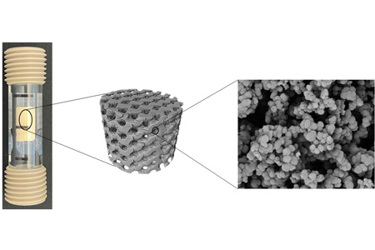
Thomas Johnson at University College London is working to show how control over geometry can matter as much as binding capacity, especially for viral vector-based modalities. His group designs and prints chromatography monoliths with projection micro stereolithography and uses X-ray computed tomography to check how faithfully each printed part matches its digital model. Early functionalized monoliths captured roughly 9 to 10 mg of bovine serum albumin (BSA) per mL, well short of commercial media from a retention perspective, but again, retention isn't always the priority.
We met Johnson in August at the Bioprocessing Summit and caught up with him later to talk about his work. In this conversation, Johnson explains where tailored geometry could earn its niche, what limits print resolution, and what regulators may want to see in a 3D-printed column on the GMP shop floor. The transcript has been edited for clarity.
For our readers who are running conventional packed-bed or membrane chromatography, what are the advantages from a designed or ordered geometry?
Johnson: Conventional packed-bed and membrane systems are really fantastic in terms of their bioseparation capability in most instances. They have great separation due to their ability for chemical and physical separation; however, they do have their flaws. They can have variability within their structures. For instance, we can see channels within packed beds. This is where 3D printing comes in as a really exciting technology. We're able to specifically tailor those physical and chemical properties working together to purify our product of interest and for our process of interest. So that customizability is powerful here, particularly for tricky separations.
You were using BSA in your testing as a model, but did you have any particular product types in mind?
Johnson: Most of the work as part of the modeling will use proteins and those relatively simpler molecules. And most of the literature you'll see both from academia and industry focuses on monoclonal antibodies. The area that I think is the most exciting and potentially has the greatest impact is looking at these more challenging separations, for example, viral vectors. We know that they've got a lot of problems within their current purification platforms. Taking this new technology approach, we may be able to overcome some of those barriers.
You talked about tomography and assessing the printed model. Can you expound on how you were measuring fidelity of the printed part compared to the computer-aided design (CAD) model?
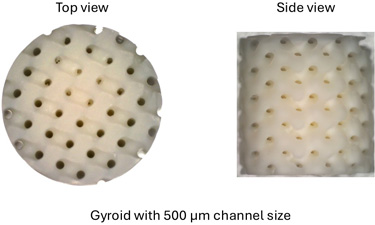
Johnson: In simple terms, first we design a CAD model on the computer. This is the idealized structure that we want to create, then we fabricate it using 3D printing. However, we're well aware that maybe what we're designing isn't necessarily the end product that comes out of the printer, particularly when we're coming up with very complex, high-resolution structures.
Do you see the tomography as a release or QC part of the process if this were to become a mainstream approach?
Johnson: A QC or release approach using high-resolution imaging is something that I spend a lot of time looking at, also for conventional resins and membranes. The reality is when you're performing high-resolution 3D printing, it can take a long time. The same with high-resolution 3D imaging — it also takes quite a long time. You're trying to balance the quality versus the reality of the amount of time that it would take. Perhaps for some initial testing to make sure that the channels aren't blocked, for example, that may be feasible. Doing some high nanoscale-resolution imaging is probably a little bit too far in terms of the QC aspect.

An earlier printer you used couldn't produce channels smaller than 750 microns, which led you to projection micro stereolithography. What limits you from achieving channels at 300 microns and below?
Johnson: Our Ph.D. researchers are spending a lot of their time in this area in terms of getting the most out of the resolution of the printer. All printers are going to have their advantages and disadvantages. Ultimately, the more resolution you have, the greater control you have over the whole 3D printing construct. It allows you to do more things with it.
It also must be counterbalanced with other factors. For instance, structural integrity, looking at the inclusion of porogens to create a substructure and many other factors which ultimately can play against each other rather than working with each other, which is kind of the pain and also part of the fun of this research. The challenge is balancing the quality and the resolution with all the other factors to get the most out of these systems.
Is it just a matter of equipment? Are you beholden to the resolution that the printers you are testing with can achieve, or is there something in the material mix that you can tweak to achieve those finer resolutions?
Johnson: It's a combination of all of those factors. There are lots of 3D printing approaches. We've tried many of them. We ended up with this approach because we found very good resolution for materials that could be biocompatible.
Looking at other approaches, for example, templating, you get much better potential scale. It can be quicker; however, you don't have that level of customizability, which in an academic setting we're really looking for in terms of pushing that envelope.
Can you talk to us about how you settled on TPO and TPOL paired with Sudan 1 — the photoinitiator and photoabsorber combinations?
Johnson: Based upon our literature survey, we looked at all relevant and viable potential photoinitiators and photoabsorbers and the combinations of them. We tested as many as we possibly could within the confines of our system. Most of them didn't work particularly well. Some of them worked very well, and those are the ones that we've continued using. We also had quite a few that we thought were going to work very well and were very promising; however, in reality, they didn't actually work well.
The photoinitiator lithium phenyl phosphinate is a good example. It's soluble in aqueous solutions, which is very desirable for obvious reasons. However, we found it had very poor compatibility with the photoabsorbers we were using, maybe because they're relatively less polar. We're still investigating and again, getting that chemical element in combination with the 3D printing design and making sure those two work together rather than working against each other. It's a real challenge that my current researchers are looking into.
Sudan 1 is toxic. Is that a concern as you consider this for GMP use?
Johnson: Ultimately, our goal is to push the envelope of what's possible. We have to look at all options in terms of viability; however, for academic research to have its maximum impact, it's got to be translatable at the end of the day.
In our initial phases, the approach and the design philosophy is to try to find the best chemical reagents, find the best printer, find the best design, et cetera, and incorporate all of those into a solution. Now, as we move into a more mature phase, those considerations are going to be integrated more in terms of toxicity, the regulatory approach, and transferability, etc. So that will become certainly more a part of it as we progress the work.
With the functionalized monolith, you recovered roughly 9 to 10 mg of BSA per milliliter of monolith with no porogen. How does that compare with the commercial anion-exchange media and what binding capacity would you need to be competitive? Are you getting better results? Is there a different type of advantage here that you are excited about?
Johnson: The performance that we showed in that very early presentation is much worse than what you'll see on the already established technologies, which is what we were expecting.
For a membrane, maybe the very best binding capacity you'll see will be around 50 mg per mL and resins two to three times that again.
In terms of where we would like to end up with this 3D printing approach, I would say somewhere probably between those two technologies. I don't think we're ever going to compete or even necessarily need to compete with the outright binding capacity of a resin, for example. However, I think even at a lower binding capacity, this technology overcomes some of the structural limitations that you see in the others. I think that we'll certainly be able to find a niche where this approach is the best option.
There is a lack of regulatory guidance for 3D-printed parts, and the industry usually borrows from medical devices, which is more established. Have you considered what regulators would want to see in a 3D-printed column?
Johnson: I think a lot of what we've already spoken about is relevant to what the regulators would want to see. The context behind this is that we've had a lot of new products coming onto the market over the past few years and passing through the clinic. We've also had a lot of separation technologies either evolving or entirely brand new ones. We've had advanced resins, we've had advanced membranes, we've also seen monoliths, and we've seen nanofibers emerging as well.
For the companies and for the regulators, if they see a technology that's giving them a great improvement in their performance and their potential product quality and overcoming some of these challenges, they are going to look favorably upon it rather than cautiously. That may not have been the case in the past when we were very focused on monoclonal antibodies and proteins.
About The Expert:
 Thomas Johnson is a lecturer in downstream bioprocessing at University College London, where he is also a senior research fellow in the biochemical engineering department. He's a member of the Institution of Chemical Engineering, the American Chemical Society, and the American Institute of Chemical Engineers. At UCL, he oversees doctoral researchers and leads collaborative endeavors with industry. He received his doctorate of engineering from UCL.