
Facility Considerations When Retrofitting Legacy Sites For ADCs
The final chapter in the series covers the facility requirements and modifications needed to operate the antibody-drug conjugate (ADC) facility. These modifications must be engineered carefully and retrofitted to the existing facility.
Facility Capability
The architectural layout of an ADC facility essentially can follow the same general rules as in a traditional biological facility; however, legacy facilities may lack important characteristics of the modern facility. There are a few necessary key aspects:
- All process suites must have personnel airlocks (PALs) dedicated for entry to the process suite and separate exit PALs from the process suite. These are needed so personnel can gown in a “clean” state and exit in an airlock where they must decontaminate their suits and don new gowns. To prevent cross-contamination, they can never be combined. Modular polymer gowning rooms (G-CON Manufacturing, AES, etc., are examples) can be installed in corridors and fitted to provide this capability.
- For the same reason, there ideally needs to be entry and exit material airlocks (MALs) to move material in and out. This is directed by the clean versus contaminated state of the MAL. As in the PAL example above, a separate MAL could be constructed or installed if space permits; however, MALs need a lot more space than PALs. An alternative is to use the current bidirectional MAL, assuming the entire MAL is decontaminated after each use by waste or any outgoing equipment.
- Unidirectional flow of all people, materials, and equipment must be built in or enforced by procedures to prevent backward flow of anything or any person from contaminated areas into non-contaminated areas. Use key cards and maglocks installed on all doors to guarantee flow compliance.
- The best practice method is to have a “clean” supply corridor attached to all the entry airlocks (PALs and MALs) and a waste/product exit corridor attached to all the exit airlocks (PALs and MALs). Most biological facilities built before 2000 used only a single corridor for bidirectional material movement. If this is the case in your facility, schedule all material transfers within the corridor to provide personnel and material in a decontaminated “clean” environment. Anything leaving the process suite must be decontaminated in the MAL, and the MAL itself must be decontaminated. Beyond this, the risk level must be evaluated, which may require the corridor to be decontaminated after the transfer of waste.
Further reference material on facility layouts can be found in some of our previous work: “An Introduction to Biopharmaceutical Facility Design & Layout” and “Bioprocess Facility Design — Layout Rules and Configurations.”
Storage
Few design organizations consider adequate storage for the various potent raw materials, intermediates, and finished product. All materials from ADC production, in any form or container, cannot be stored with the common GMP or inert materials. Therefore, separate and adequate storage must be built and readily accessible to the exit corridor.
ADCs are notoriously sensitive to temperature post-conjugation reaction, requiring refrigeration. Therefore, during a renovation, the new separated storage area must be built with various validated temperature-controlled environments (ambient, minus 20 C, and minus 80 C). Volumes should be estimated and then doubled in space to accommodate future expansion.
Another important aspect is the number of disposables (SUS) to be employed in the processes and which ones require secure, clean storage. Bioreactors should be stored separately in both the mAb facility and the ADC facility. The dedicated ADC bioreactors, TFFs, chromatography columns, and the many transfer and holding bags require substantial space. Disposable isolators will use substantial storage volume even as each unit is compressed, wrapped, and boxed. Current and anticipated space needs must be estimated when designing the new storage area.
Common waste containment bags will consume substantial floor space in the storage area, as all material moved out of process suites will be double or triple bagged.
Finally, beyond physical storage space, the high volume of concentrated polymeric materials in storage will require a potential fire suppression system redesign to meet the local fire codes.
Architectural Finishes
Legacy facility retrofitters must audit the condition of their proposed process suite and all interior finishes (walls, floors, and ceilings) to ensure all the surfaces that potentially could be decontaminated are smooth, monolithic, and either stainless steel or coated with a chemical-resistant epoxy. This may require an analysis of the walls and ceilings. Legacy facilities may have an older epoxy painted over a mold-resistant gypsum board. These legacy surfaces will not last the repetitive level of decontamination and sanitizing. The recommended remediation of this is to either cover the existing wall surfaces with polymer panels (e.g., AES panels) or thin polycarbonate polymer membranes (e.g., Mipolam ) or tear out old gypboard and replace it with a resin board (e.g. GP DensArmor+), resin sealer in the joints, and a coat of chemically resistant epoxy paint.
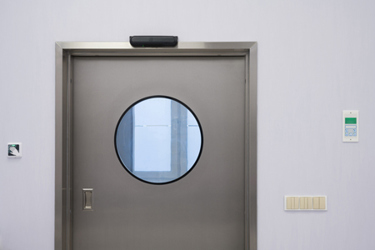
Interior process suite doors must be decontaminated like all the other surfaces, but they need fresh seals to withstand decontamination and sanitization cycles. Any rollup doors in the interior of the process areas must be replaced with stainless-steel swing doors. Rollup doors will retain toxins in the overhead spool, cannot stand up to the decontamination and sanitization cycles, and do not provide a robust pressure seal.

HVAC
To maintain containment of the payload API or other downstream material, HVAC is the single most critical plant capability.
- All ADC process suites must be negatively pressurized relative to the outside reference to assure any dust or aerosolized material stays in the suite.
- All the airlocks must function as “air bubbles” pressurizing air into the suite and the corridor. This maintains an “air curtain” or barrier.
- Depending on the material transfer paths, other areas (corridors, pass-throughs, etc.) may need to be negatively pressurized.
- All areas or suites that are negatively pressurized for containment must have the HVAC on backup power and must provide battery-backed UPS N+1 exhaust fans to maintain containment under any circumstances, even the transition time between a power outage and the backup generator coming online.
- All process suites with high EP must have HEPA filters on the return registers to protect the internals of the HVAC system and not contaminate the blowers, drives, plumbing, coils, etc. The return HEPAs must be changed within the suite, bagged, and discarded when changed out. An alternative to the in-suite HEPA for legacy plants is to install a bag-in-bag-out (BIBO) filter system installed in the return AHU ductwork before any mechanicals. The BIBO systems allow a safe HEPA extraction within a bag, ready for removal and disposal. The BIBO module needs to be encapsulated in a modular room that is negatively pressured if installed inside the building's mechanical space.
- The negative pressure, backup exhaust fans, and HEPAs on the return are required for safety and containment. Most legacy retrofits can replace the HVAC with a BIBO system, add the exhaust fans off the HVAC return, and rebalance the air pressure for the negative suite. After the rebalance and modifications, the HVAC must be revalidated.
Automation
Automation is specifically focused on the process knowledge and the use of model-based, closed-loop PAT control of the conjugation reaction. However, as new processes evolve and scale changes, processing suites need advanced communications. Specifically, they require high-bandwidth Wi-Fi to capture data from any skid-based system.
Isolators
One of the most critical pieces of equipment is the isolator, but there's disagreement about which one is better: flexible polymer, disposable isolators, or rigid stainless-steel isolators. The issues are:
Rigid isolators
- They need decontamination liquid deluge systems internally for decontamination.
- A swab study/decontamination study/decontamination validation will be required for use.
- At the end of each decontamination cycle, a VHP cycle will be needed for sanitization.
- The isolator use cycle (dispense, decontamination, dry, VHP, degas, test, ready) takes a substantial time per batch and limits capacity.
- The isolator will require an analytical method development for decontamination validation within the isolator.
- They have a high capital cost, with typical custom-built isolators running between $500,000 and $1 million.
- The liquid effluent needs to be hard piped to the process waste system.
Flexible disposable isolators
- These have a minimal capital cost; only a desktop or stainless-steel cage frame is needed.
- Low operating cost ($1,000 to $5,000 per unit); however, many units will be consumed during campaigns.
- No decontaminating, no cleaning, and no SIP are needed.
- When finished, the flexible isolator is removed, collapsed, and sent to hazardous solid waste disposal.
- All the tools used inside the isolator (disposable tools, SUS process equipment, and scale cover) can be rolled up in the isolator upon batch completion and disposed of.
People
The final aspect of converting a legacy facility to an ADC producing one is teaching all the employees about the hazards of the payload API and the varying levels of ADC product. The organization must assure them that the engineering modifications, when worked in concert with their SOPs, will provide lifesaving therapies to their patients and keep them and their operating colleagues safe. Some aspects to emphasize include:
- the toxicity of the raw material API and the downstream intermediates
- containment and the necessity of maintaining control of every material that enters the process suite
- understanding the need to decontaminate when in doubt and recognizing when an emergency arises to decontaminate
- decontamination does not mean sanitization.
Summary
Conversion from a legacy biotech facility to one that can process ADCs demands a passionate focus on personnel, safety, and environmental containment. This must be an integrated effort of engineering design in architecture and HVAC, new equipment systems, new procedural methods, and careful training.
About The Authors:
 Herman F. Bozenhardt has 50 years of experience in pharmaceutical, biotechnology manufacturing, engineering, and compliance. He is a recognized expert in aseptic filling facilities and systems and has extensive experience in the manufacture of therapeutic biologicals and vaccines. His current consulting work focuses on aseptic systems, liposomes, biological manufacturing (BL-1, BL-2, BL-3), and automation/computer systems. He has a B.S. in chemical engineering and a M.S. in system engineering, both from the Polytechnic Institute of Brooklyn (now NYU). He can be reached via email at hermanbozenhardt@gmail.com and on LinkedIn.
 Erich H. Bozenhardt is the associate director of process engineering for United Therapeutics in Raleigh, North Carolina. He has 20 years of experience in biotechnology and aseptic processes and has led several biological manufacturing projects, including cell and gene therapies, mammalian cell culture, and novel delivery systems. He has a B.S. in chemical engineering and an MBA, both from the University of Delaware. He can be reached via email at erichbozenhardt@gmail.com and on LinkedIn.