
Fab Antibody Fragment Titer Improvement
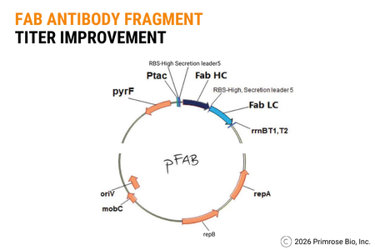
When your E. coli platform isn't delivering the Fab titers needed to support clinical development, the path forward often comes down to systematic strain engineering and high-throughput screening. In this case, a development partner needed active Fab fragment titers above 2 g/L to make their process economically viable, but their existing platform was falling well short of that target.
The screening workflow began at 96-well scale across 800 unique expression strains, evaluating 160 plasmid configurations that varied codon optimization, secretion leader sequences, and ribosome binding sites. Down-selected candidates were then assessed at 2L fermentation scale under multiple induction conditions, including variations in pH, temperature, induction OD, timing, and inducer concentration. Fab was enriched from fermentation pastes by affinity chromatography and confirmed for intact mass by LC-MS.
The results showed the top-performing strain reached an average lysate titer of 4.8 g/L by SDS-CGE and 4.5 g/L by BLI at 96 hours post-induction, more than doubling the original threshold. Assembled Fab was produced consistently over the full induction period. If you're facing similar titer constraints on a Fab or antibody fragment program, review this case study to evaluate whether a high-throughput microbial strain screening approach fits your development timeline.
Get unlimited access to:




Enter your credentials below to log in. Not yet a member of Bioprocess Online? Subscribe today.