
Exploring Takeda's Template For Sustainable Steam Generation
A conversation between Takeda's site head Vienna, Maria Löflund, and Life Science Connect's Jon O'Connell
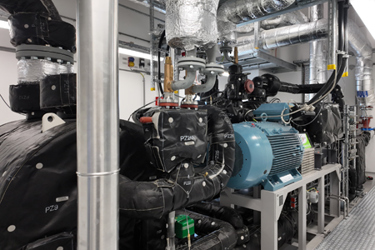
At Takeda's Vienna campus, a system of staged heat pumps and vapor compression creates high-pressure steam, going toe-to-toe with natural gas-fueled steam generators.
The project, called AHEAD or Advanced Heat Pump Demonstrator, was built into an operational facility, a key manufacturing hub where Takeda produces plasma-based therapies.
The company received a 2026 ISPE Facility of the Year Award in the sustainability efforts category. Maria Löflund, Vienna site head, offered to walk us through the project.
Most industrial heat pumps struggle to reach the high temperatures required for GMP steam. How does the AHEAD system reach temperatures for sterilization? Is this a single-stage lift or a multi-stage cascade system?
Löflund: Generating high‑pressure steam for pharmaceutical sterilization is one of the most demanding applications for industrial heat pumps. Conventional systems typically struggle to exceed temperatures of 120 degrees C to 150 degrees C. AHEAD overcomes this limitation through a deliberately multi‑stage concept instead of relying on a single extreme temperature lift.
The system combines a high‑temperature heat pump with mechanical vapor recompression using natural refrigerants and is fully powered by renewable electricity. Waste heat from Vienna’s central chiller system is upgraded step by step — from hot water to saturated steam and finally to high‑pressure steam.
The project is a collaborative effort between Takeda, the Austrian Institute of Technology (AIT), and Sustainable Process Heat (SPH), supported by the Austrian Climate and Energy Fund. It enabled the development of a steam‑generating system that currently delivers steam at 11 bar(a) and up to 184 degrees C, fully meeting GMP sterilization requirements.
Rather than concentrating the temperature lift in one step, the staged approach improves efficiency, operational stability and controllability — key requirements in a GMP‑regulated environment. Importantly, AHEAD was not set up as a laboratory pilot. From the start, it was planned as a fully operational utility-scale system at one of Takeda’s largest pharmaceutical manufacturing sites.
The project uses natural refrigerants, which are more environmentally friendly but come with increased safety risks. Can you talk about the decision to use butane and any added safety measures required to use it?
Löflund: The decision to use n‑butane (R600) as the refrigerant was a deliberate environmental choice. Butane is a natural refrigerant with zero ozone depletion potential and negligible global warming potential. From an energy perspective, it also offers excellent thermodynamic properties, which are critical when targeting very high temperatures.
However, butane and its use in an industrial, GMP-regulated environment require a comprehensive safety concept. From the earliest design phase, the team treated protection and risk mitigation as core design criteria. All materials, components, seals and electrical equipment were selected to meet the stringent requirements.
A dedicated building was constructed to physically separate the AHEAD system from pharmaceutical production areas. Advanced safety systems include continuous gas detection, forced ventilation, emergency shutdown mechanisms, and pressure relief systems. For regulatory approval, detailed computational fluid dynamic (CFD) simulations were conducted to model worst-case scenarios, such as pressure relief events and to validate safe dispersion behavior.
In addition, Takeda introduced rigorous operational procedures and training programs for both internal staff and external contractors. These measures ensure that the use of butane does not compromise safety or patient supply. The project demonstrates that natural refrigerants can be safely deployed at industrial scale — provided safety is embedded into the design from day one.
Can you talk about specific challenges of inserting a project of this scale and significance without disrupting production?
Löflund: One of the challenges of AHEAD was integrating a first-of-its-kind energy system into a fully operational GMP manufacturing site — without any disruption to production or patient supply.
To address this, a standalone energy building was constructed specifically for AHEAD. This allowed construction, installation, and testing activities to take place independently of production areas. Detailed interface planning ensured seamless integration with existing utilities (steam, cooling, and control systems) while minimizing physical and operational overlap.
Another challenge was working within strict regulatory and validation frameworks. Any modification to utilities must be documented, qualified, and approved. The team implemented extensive testing, simulation-based planning, and staged commissioning to ensure compliance at every step.
Seasonal variability added further complexity. The availability of waste heat, heating demand, and steam demand varies throughout the year, leading to frequent partial-load operation. This required highly sophisticated control strategies and extensive simulation. More than 160 annual scenarios were modeled to optimize system behavior.
Finally, coordination was key. More than 10 planning and construction companies were involved, alongside research and technology partners. The coordinating team ensured close project governance, clear responsibilities, and continuous alignment so that innovation progressed without compromising safety, quality, or production continuity.

Is redundancy baked in? If AHEAD goes down for maintenance, do you need to maintain a validated backup?
Löflund: Redundancy and supply security are essential, especially in pharmaceutical manufacturing. AHEAD was deliberately designed as a complementary system, not a single point of failure. Existing conventional steam generation infrastructure remains in place as a fully validated backup.
If AHEAD is offline — whether for maintenance, inspections, or optimization — the site can immediately revert to conventional steam supply without any impact on GMP compliance or production. From a regulatory standpoint, this ensures continuous validated conditions for sterilization and processing.
Operationally, this hybrid setup was a key prerequisite for approval. It allows Takeda to deploy innovative technology while maintaining the reliability standards required for patient-critical production. Over time, as confidence and operational experience grow, the share of steam covered by AHEAD can increase, but fallback capability remains assured.
The system itself is designed for reliability. Built-in monitoring, remote diagnostics, and predictive maintenance tools help identify potential issues early and reduce unplanned downtime. Scientific monitoring over more than 4,000 operating hours ensures that performance, stability, and safety are continuously documented.
In short, AHEAD enhances environmental sustainability without compromises.
Takeda calls this a “demonstration.” What success markers are you looking for to determine whether it can be rolled out elsewhere?
Löflund: “Demonstration” does not mean pilot in the traditional sense. For Takeda, AHEAD is a fully industrial, utility-scale system operating under real GMP conditions. The term reflects its role as a reference project for broader replication rather than a temporary trial.
Success is evaluated across multiple dimensions.
- Technical performance: The system can reliably deliver high-temperature steam under real operating conditions, including partial load and seasonal variability.
- Energy and emissions impact: AHEAD targets up to 80% CO₂ reduction for steam generation and savings of around 1,600 tons of CO₂ annually at one of the largest production units in Vienna.
- Operational integration: Performance during continuous operation, maintenance requirements, and compatibility with established pharmaceutical processes are closely monitored. Scientific monitoring by AIT over extended operation provides data-driven validation.
- Scalability and transferability: The simulation models and open documentation are designed specifically to support replication at other Takeda sites and across other industries.
Finally, success includes knowledge sharing. Takeda deliberately chose not to patent AHEAD. By opening the energy center to other companies and publishing results, the project aims to help accelerate decarbonization beyond Takeda. If others can realistically adopt the concept, the demonstration has succeeded.
Is the technology limited to high-volume processes that inherently produce more heat, like large-scale fermentation?
Löflund: AHEAD clearly benefits from sites with significant waste heat streams, but it is not limited to very specific processes such as fermentation. The underlying principle is energy integration: upgrading low- to medium-temperature waste heat to the levels required for industrial steam.
Pharmaceutical manufacturing is particularly demanding because of its high steam quality and pressure requirements, making Vienna an especially challenging test case. If the system works here, it provides strong proof of robustness. However, similar waste heat sources exist in many industries, including food processing, chemicals, paper, and advanced materials.
What matters most is not a specific process type, but the availability and continuity of heat sources combined with sufficient steam demand. The modular design allows adaptation to different temperature levels, load profiles, and energy infrastructures.
The extensive simulation approach — more than 160 modeled scenarios — demonstrates that performance can be tailored to site-specific conditions. While very small sites — or sites where heat is not available continuously — may be less suitable, many medium- to large-scale industrial facilities could apply the concept.
In this sense, AHEAD deliberately pushes the upper boundary of what is technically possible. It shows that even the most challenging steam applications can be decarbonized, widening the potential application space.
Did EU carbon pricing and emission reduction incentives make a cutting-edge installation like this feasible? Practically, could you install one in the U.S. or other regions where gas is cheaper and there’s no carbon tax?
Löflund: Policy frameworks clearly helped create the right conditions for AHEAD. Targeted funding, such as support from Austria’s Climate and Energy Fund, are important factors.
That said, AHEAD was not driven by subsidies alone. Its feasibility rests on long-term strategic considerations: decarbonization and efficiency targets, energy security, and resilience against volatile fossil fuel prices. Projects must always deliver environmental benefits while also making economic sense.
In principle, the technology is not region-specific. AHEAD could be installed worldwide, including in the U.S. It is designed from the ground up for global impact and replicability. Its data-driven approach and open knowledge sharing have already inspired more than 50 companies and attracted international recognition at events such as COP28 and the World Expo 2025, and with three awards: the Net-Zero Industries Award, a DECA Award, and now also ISPE FOYA.
Beyond advancing Takeda’s emissions goal of net-zero in its operation by 2035, AHEAD also strengthens local value creation. The project’s impact extends from the factory floor to the global stage, catalyzing a new era of environmental responsibility in industrial production. With the decision not to patent AHEAD, Takeda takes responsibility for society urgently needing low or zero CO₂ emissions solutions in industry settings globally.
About The Expert:
 Maria Löflund has more than 20 years of experience in the biotech industry and has worked as a site head Takeda in Vienna since 2023. Previously, she worked as a site head for Lonza and before that for Shire, which later was acquired by Takeda. She earned her M.Sc. from Helsinki University and her Ph.D. from Vienna University of Technology.