
Cell & Gene Therapies: SUT Connection Lessons From Biotech
By Derek Pendlebury

Recent FDA approvals of cell and gene therapies (CGTs) are the green light for tackling the manufacturing challenges of these new offerings. Key needs for manufacturing CGTs are speed, sterility, and reduced costs. Industry experts expect single-use technologies (SUTs) to deliver on those needs for CGTs like they do for commercial production of biopharmaceuticals. Choosing the right SUTs for each therapy will require a steep learning curve. But CGT makers do not need to start from scratch. They can adopt lessons from the processing of biologic drugs which have some similar needs.
While SUTs are used for development of CGTs today, those used at the laboratory scale cannot always transfer into commercial manufacturing for a variety of reasons, including extractables, leachables, supply chain security, reproducibility, and scalability. The industry needs to overcome these challenges and develop solutions in the near future to avoid capacity shortages.
The scope of this paper does not permit exploration of all SUTs, but instead focuses on one important SUT decision — fluid connection technology. This is one of the most important, but often overlooked, decisions when developing a single-use-based process.
Connection technology brings all the pieces of the single-use jigsaw together. The right connection technology can allow the aseptic connection of single-use to non-single-use steps in the process while maintaining a fully closed system. The wrong connection technology can have serious implications on the scalability, reproducibility, and security of the process.
The process setting influences the type of connection technology used. In a laboratory setting, the system typically has open components and manual processing. In a clinical setting, the system often uses closed connectors and processing and a manual process with some automation. In a biopharmaceutical commercial production setting, the system is influenced by the longer-term goal of commercialization. To achieve commercialization, the typical system is fully closed with some manual processing but utilizes a high level of automation.
Connection technologies are categorized into two broad types:
- tube welders — which connect by welding or fusing two fluid paths
- connectors — which mechanically couple two components installed in the fluid pathway.
When To Use A Tube Welder
Tube welders are widely used in both laboratory and clinical environments to form sterile tubing connections and are also used in the commercial production of some biopharmaceutical drugs. Typically, these are applications where a small number of connections per day are required, where only one size and type of tubing is used, or where a small number of production batches is required.
How Do Tube Welders Work?
Tube welders work by heat-welding tubes together using an end-to-end weld, also called a butt weld. Most tube welders join two tubes together to form a single weld joint; however, some can make two welds simultaneously.
The critical component in the welding process is the blade used to both cut and heat the tubing. During the process, the blade is heated to the correct temperature, then moved to cut the tubing. The open ends of the tubes to be joined are positioned opposite each other while the blade is still in position. Once the blade is retracted, the two ends of the tubes are brought together and a weld is formed.
The temperature of the blade during the heating process, approximately 500 degrees Fahrenheit (260 degrees Celsius), is high enough to both weld the tubes and maintain sterility of the cut ends during the process to produce a sterile connection.
Choosing Between Tube Welders And Connectors
A number of factors may rule out the use of tube welding. For instance, tube welding requires the use of thermoplastic tubing. Silicone tubing, a popular choice in biotech, cannot be welded. A long list of additional factors to consider about tube welders is available in Cell & Gene Therapies: A Guide To Single-Use Connections.
Connectors can offer several advantages over tube welders when designing a system. These include:
- flexibility to work with any type of tubing and allow any type of tubing to be connected to any other
- no electricity required
- little, if any, training needed
- no maintenance required
- no particulates generated
- faster speed of connection.
Important Factors For Connection Technology
Ease of Use
The risk of operator error increases with more complexity and steps required to make a connection. Aseptic connectors are offered in a variety of designs requiring from 3 to 10 steps by an operator to make a connection. Simpler is always better.
Robustness
Connectors need to withstand intended use as well as unintended abuse. One of the most common issues with connectors is their inability to withstand side loading. Side loading can occur after a connection is made if the connector is subject to external forces that distort the connector and may compromise the security of the connection.
Secondary Equipment
Ideally, connectors should not require additional equipment such as tri-clover clamps, fixtures, or assembly aids to make the connection. If more equipment is required, this may indicate the connector is not as robust as the process requires, and the entire single-use assembly may be compromised.
Seal Design
The seal design is the last line of defense against leakage or microbial ingress into the connector and the system. Larger, more robust seals in both halves of the connector are preferred over smaller, less robust seals, which are sometimes located in only one half of the connector.
Understanding Single-Use Connector Types
The two types of connectors are open and aseptic. Open connectors require a controlled environment in which to make an aseptic connection. Aseptic connectors, in either gendered or genderless form, can make a sterile connection in any environment, including one with a high bioburden.
Open Connectors
An open connector is any connector technology that requires a sterile or aseptic environment in which to make a sterile connection. The most common examples include luer fittings and MPC-type connectors. These connectors are installed on a single-use system and plugged or capped to seal the connector and maintain sterility until use, followed by bagging the complete assembly and gamma-irradiating it for sterilization. They are typically used in a laminar flow hood that provides a sterile environment when the connection is being made.
Open connectors have two parts which are not the same, as shown in Figure 1. This type of connection is typically referred to as a gendered connector, as they are composed of a male connector and a female connector. To make the connection, the two parts are brought together and locked. This means during the design stages of a single-use system, the orientation of each connector on each tube and its relation to the component it is connecting to must be planned to ensure the whole assembly will connect together when in use. When mistakes are made at the design stage of a single-use system, the end result can look like Figure 2.
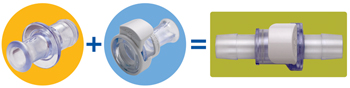

If open connectors are used to connect a system in an uncontrolled environment such as an open laboratory bench, once the caps or plugs are removed from the connector, the connector fluid path is no longer sterile. The sterility of the entire system being connected is compromised. Yet these types of connectors can be used to make an aseptic connection, for example, when used under a laminar flow hood.
Some advantages of open connectors include intuitive use, inexpensive cost, wide variety of sizes, and a broad number of sourcing options.
Aseptic Connectors
Aseptic connectors are a significant advancement in the science of connection technology because they allow the end user to make a sterile or aseptic connection in an uncontrolled environment as well as in a controlled environment.
Currently, all aseptic connectors work by simultaneously removing two porous sterile barriers, usually membranes, from the connector assembly to open a sterile fluid pathway once the two components of the connector have been brought together. Aseptic connectors vary widely in simplicity of use and the range of tubing types and sizes that can be accommodated.
How Aseptic Connectors Work
Each connector half is supplied with a protective barrier, usually a membrane, welded across the fluid flow path. Once the connector is assembled into a system and sterilized, the protective barrier prevents bacteria and contaminants from entering the fluid pathway while the barrier is in place.
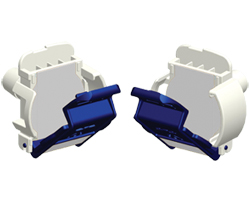
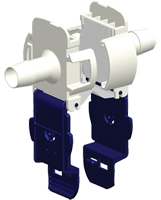
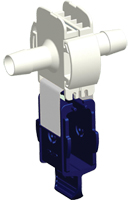
In the example in Figure 3, the dust covers are flipped down to expose the membrane. The two halves of the connector are pushed together until an audible click is heard from both sides, indicating a secure connection has been made, as shown in Figure 4. The membrane barriers are clicked together and then pulled from the assembled connector to open the sterile fluid pathway, as shown in Figure 5.
Most aseptic connectors require a final twist of the assembly to securely lock the two halves together after the membrane has been removed. This represents a potential for operator error if the final twist is not completed and can result in a non-sterile connection. However, the connector shown in Figures 3, 4, and 5 only requires a push fit to make a secure connection, and the removal of the membranes is the last step in the process.
Choosing Tubing Sizes For Aseptic Connectors
Aseptic connectors are designed to work with a range of tubing sizes. However, because the technology was initially developed to support the biopharmaceutical processing market, the development focus of most suppliers has been on systems to handle larger flow rates, not on small-volume fluid handling. Therefore, it is imperative to consider the complete range of available tubing sizes that can be used with a connector family when selecting a connector.
Most suppliers have connectors with ¼”, ⅜”, ½”, and either ⅝” or ¾” options. Only one supplier, Colder Products, has a family of aseptic connectors in the 1/8” range.
Learn more about gendered connectors, genderless connectors, advantages of genderless connectors, and the path forward for CGT commercialization in our comprehensive guide, Cell & Gene Therapies: A Guide To Single-Use Connections.
About The Author
Dr. Derek Pendlebury has worked for over 32 years in the development and supply of SUTs for the biopharmaceutical industry. His experiences include sales, product management and development, sales management, corporate marketing, and corporate management in senior positions with Sartorius, Pall Corporation, Agilent Technologies, 3M, ATMI, and Charter Medical. Pendlebury has authored numerous papers and book chapters and has presented on SUTs at over 20 conferences. He is an active member with the BPSA, PDA, and ISPE. He holds a Bachelor of Science in biology from Coventry University, U.K.; a master’s in marine biology from the University of Leeds, U.K.; and a doctorate in marine biology from the University of Manchester, U.K.
About Colder Products
The leader in single-use connection technology offers a wide variety of bioprocessing connection solutions that ensure reliable and sterile connections. Innovative designs from Colder for sterile fluid transfer, even in nonsterile environments, now come in a range of connections including 1/8”, ¼”, 3/8”, ½”, ¾”, and 1” flow configurations. For applications where security is a must, connect with CPC – Colder Products Company at cpcworldwide.com/bio. Or contact one of bioprocessing application connectologists at info@cpcworldwide.com.