
Can Peptide Mapping Predict Intact Antibody PTM Distributions?
By Neeraj J. Agrawal
Peptide mapping is widely used to identify and quantify post-translational modifications (PTMs) at specific amino acid sites. Enzymatic digestion produces peptides that can be measured by liquid chromatography-mass spectrometry (LC-MS) or related methods. Because digestion separates the peptides from one another, the resulting measurements do not show which modifications were present together on each intact antibody molecule.
This distinction matters when site-level measurements are used to infer whole-molecule populations. Two samples can have the same average modification level at each measured site yet differ in how those modifications are combined across molecules. One population may contain mostly molecules with one modified site, while another may contain more molecules at the extremes: no modified sites or several modified sites.
At one extreme, if no intact molecule has the modification on both heavy chains, then 80% of molecules have it on exactly one chain and 20% have it on neither.
At the other extreme, if the modification always occurs on both heavy chains together, then 40% of molecules have it on both chains and 60% have it on neither.
These two cases represent limiting patterns of how modified chains are paired. Under a separate assumption that modification of the two heavy-chain copies occurs independently, 16% of molecules would have both copies modified and 48% would have exactly one copy modified. Thus, the same peptide-map result can be consistent with different intact-molecule distributions. In a bioreactor harvest, variation in molecule age can further affect that distribution.
Table 1
| Number of modified heavy-chain copies in intact molecules | Fraction (%) | ||
|---|---|---|---|
| Assuming that no molecule has the modification on both heavy chains | Assuming that modifications always occur on both chains together | Assuming that modification of the two heavy-chain copies occurs independently | |
| 0 | 20 | 60 | 36 |
| 1 | 80 | 0 | 48 |
| 2 | 0 | 40 | 16 |
A simple model of an immunoglobulin G (IgG) with one modification site on each heavy chain illustrates why production history matters. It predicts different intact-molecule distributions for a bioreactor harvest and a same-mean, single-exposure-duration stability comparison, even though both cases have the same peptide-map modification level. These are illustrative model outputs, not experimental findings.
Peptide Mapping Makes A Useful Tool But Does Not Reveal Intact-Molecule Distributions
Peptide mapping is a central tool for confirming protein sequence and locating or quantifying site-specific modifications. After enzymatic digestion, modified and unmodified forms of a target peptide are measured by LC-MS or related methods. The resulting site-level estimate depends on sample preparation, peptide recovery, and the relative response of the modified and unmodified forms.
Peptide mapping reports marginal modification levels at measured sites. It does not, on its own, identify which modifications coexist on the same molecule or how modifications are paired across the two heavy chains. When a decision depends on those combinations, peptide mapping can be complemented by methods that preserve more molecular context.
Earlier antibody literature addresses this inference gap directly. Goetze et al. explain that peptide maps quantify an attribute per chain but lose how modified chains are paired; the fraction of intact antibodies carrying an attribute therefore depends on the pairing pattern, and selective purification can bias measured attribute levels.1 Compton et al. formalize the broader limitation: Bottom-up digestion loses correlations among PTMs on different peptides, so site-level measurements do not uniquely determine the proteoform distribution.2
This model asks whether peptide-map data for a single modification can reveal intact-molecule distributions formed during bioreactor production; downstream purification and storage are addressed in the concluding section.
A Toy Model Shows Why Molecular Context Matters
For this toy model, consider an IgG with two heavy chains and two light chains. Each heavy chain carries one copy of a site that can undergo a PTM, such as oxidation, deamidation, isomerization, or glycation, during bioreactor production or storage. PTMs such as glycosylation that occur only during protein expression are excluded from the following analysis.
Across the intact molecule, this gives three possible counts of modified sites: zero, one, or two (Figure 1).
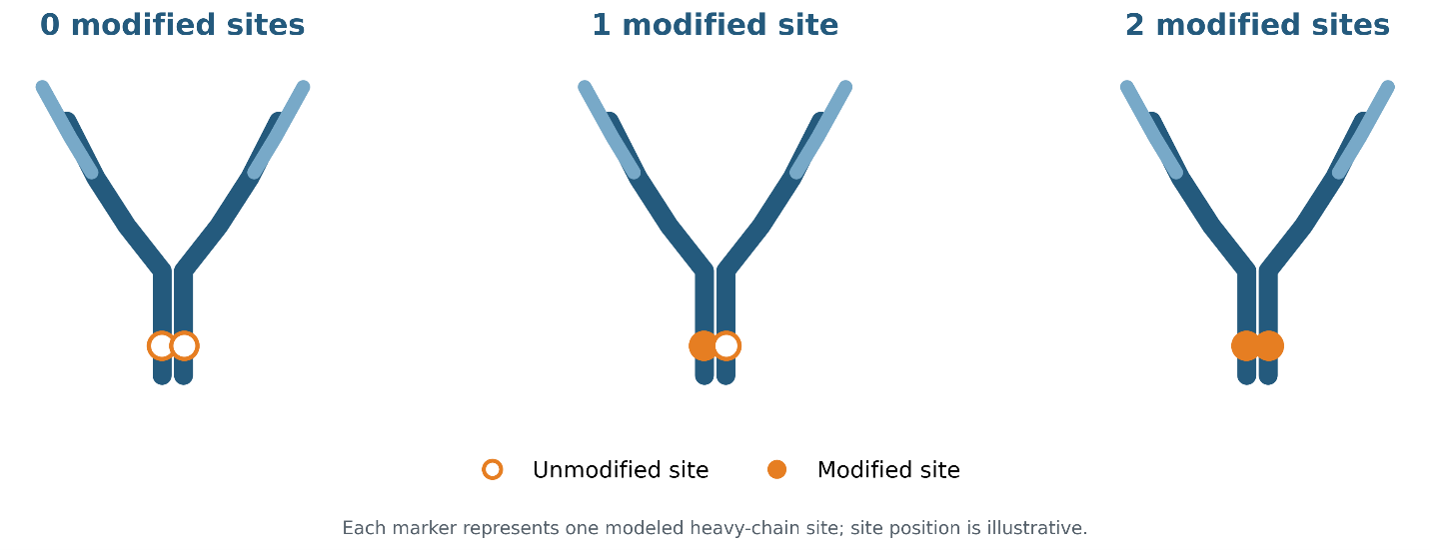
Figure 1. Schematic of an IgG with zero, one, or two modified sites.
Case A: Bioreactor, age-aware harvest. Assume antibody is secreted at a constant rate for 14 days, with no product loss before harvest. The harvested pool therefore contains equal amounts of antibody across molecule ages from 0 to 14 days.
Assume the modification follows first-order kinetics3 with an assumed rate constant k = 0.080447 day⁻¹. With constant secretion and no product removal during the 14-day interval, the molecular age “a” at harvest is uniformly distributed. Here, k = 0.080447 day⁻¹ was selected to yield a 40% age-averaged modification at T = 14 days; it was not estimated from experimental data or literature.

At molecular age a, the probability that a given site is modified is  .
Hence, the age-averaged modification probability looks can be written as:

At T = 14 days and k = 0.080447 day⁻¹, the model predicts an age-averaged site-level modification of 40% (and an unmodified fraction of 60%).
To obtain the intact-molecule distribution, first consider molecules of a fixed age a. Assume the two heavy-chain copies act independently. The probabilities of zero, one, or two modified copies are  ,
 , and
 , respectively. Because harvested molecules span ages uniformly from 0 to T, average each fixed-age probability over that age distribution.
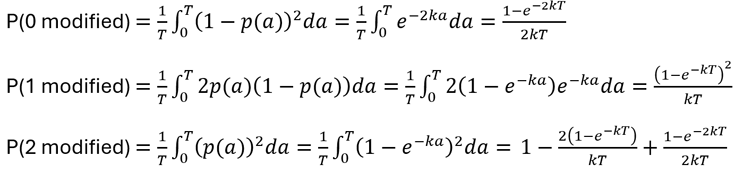
Case B: Stability, same-age comparison.
This case uses the first-order kinetic framework described by Ionescu and Vlasak, who related degradation rates observed at the peptide and molecular levels to predict molecular species distributions.3 In an actual stability study, the harvested sample contains molecules with different culture residence times and may already contain modified forms at the start of storage. For this toy comparison, we assume that the modeled modification level is zero at the start of the exposure and that all molecules experience the same storage duration. This simplification isolates the effect of age heterogeneity in Case A; it does not represent the pre-existing modification distribution or culture-age distribution of a real stability sample. To keep the math simple and analysis comparable to Case A, we further assume that after storage for a certain amount of time, the site level modification is 40%.
Because every molecule in Case B has the same age, each heavy-chain site has modification probability q = 0.4. Assuming independent outcomes at the two copies, the probabilities of zero, one, or two modified copies are (1 − q)², 2q(1 − q), and q², respectively. This case also assigns identical modification probabilities to the two heavy-chain sites and assumes independent outcomes. Site-specific structural differences could violate these assumptions in a real product.
Age Heterogeneity Shifts Intact-Molecule Distributions
Both cases have the same peptide-map site modification level of 40% but predict different intact-molecule distributions. Table 1 shows Case A after averaging across the uniform 0-14-day age distribution and Case B, in which every molecule has the age. The difference arises from age heterogeneity, not from a difference in the peptide-map mean.
Table 2. Predicted intact-IgG fractions by number of modified heavy-chain copies, for Case A and Case B.
| Number of modified heavy-chain copies in intact molecules | Fraction (%) | |
|---|---|---|
| Case A | Case B | |
| 0 | 39.73 | 36.00 |
| 1 | 40.55 | 48.00 |
| 2 | 19.73 | 16.00 |
What The Model Leaves Out
The model assumes constant antibody secretion and no product loss before harvest. In a real fed-batch process, productivity changes with culture age, while growth, viability, volume, harvest timing, degradation, or selective loss can alter each age group’s contribution. Feed schedule, feed strategy, and mixing can also change the time course of productivity and therefore the age distribution of antibody in the harvest.
The reaction model is simplified, and actual modification kinetics may follow a more complex mechanism.
Peptide-map results can be affected by digestion efficiency, peptide recovery, ionization response, missed cleavages, and sample-preparation artifacts.
Inferring Intact-Molecule Distributions Requires Complementary Methods
Peptide mapping can quantify modification at the site level, but by itself it cannot determine how modified copies are distributed across intact antibody molecules. In this model, Case A and Case B have the same peptide-map mean of 40%, yet yield different fractions of molecules with zero, one, or two modified copies. The bioreactor harvest combines molecules of different ages, while the stability comparison gives every molecule the same exposure duration. Thus, a site-level modification measurement does not uniquely specify the intact-molecule distribution.
In practice, peptide-map PTM levels reflect cumulative history across bioreactor production, downstream purification, and storage. Purification may selectively enrich or remove particular modified forms, and storage can add further modifications. These sequential and selective effects make intact-molecule distributions more complex than the simplified model. Peptide mapping remains valuable for identifying and quantifying site-specific changes; when decisions depend on the distribution across intact molecules, it should be complemented by methods that preserve molecular context.
Key Takeaways:
- Peptide mapping quantifies the average modification level at a site, but it does not show how modified sites are distributed across intact antibody molecules. The distribution may matter when modification affects product quality or function.
- A 40% peptide-map result does not, by itself, establish the intact-molecule distribution. For two sites modified independently at the same age, 16% of molecules would have both sites modified. In a bioreactor harvest, molecules have different ages, so the predicted fraction can differ even when the average peptide-map result is the same.
- In general, “older” molecules in a bioreactor harvest will not only have a higher level of PTM but also a higher fraction of intact molecules with both chains carrying the PTM.
- The difference between a bioreactor harvest and a same-age stability sample depends on the modification level. The distributions tend to be more similar at lower levels of modification.
- Intact-molecule PTM distributions reflect the combined effects of bioreactor conditions, downstream purification, and storage. Purification can enrich or remove particular modified forms, while storage may introduce further modification.
- Real antibody products contain multiple PTMs, and their combinations make intact-molecule distributions more complex than this single-modification model can represent.
- Bioreactor age distribution and modification kinetics can depend on production rate, pH, temperature, and other process conditions, including bioreactor mode (fed-batch vs. perfusion). Changes during scale-up or process transfer may therefore alter the intact-molecule distribution, even if peptide-map site levels appear similar.
References:
- Goetze AM, Schenauer MR, Flynn GC. Assessing monoclonal antibody product quality attribute criticality through clinical studies. mAbs. 2010;2(5):500–507.
- Compton PD, Kelleher NL, Gunawardena J. Estimating the distribution of protein post-translational modification states by mass spectrometry. J Proteome Res. 2018;17(8):2727–2734.
- Ionescu R, Vlasak J. Kinetics of chemical degradation in monoclonal antibodies: relationship between rates at the molecular and peptide levels. Analytical Chemistry. 2010;82(8):3198–3206.
About The Author:
 Neeraj Agrawal, Ph.D., is a senior director in process development at Amgen, where he leads the pivotal attribute/analytical sciences team overseeing analytical control strategies, product characterization, and method development. Previously, he worked as a scientist at Ipsen. He received his Ph.D. in chemical engineering from the University of Pennsylvania and did postdoctoral work at MIT.