
Argonne Begins Testing of TB Biochip
A new biochip technology developed by Russian and American scientists may help stem the global resurgence of tuberculosis. Developed by the U.S. Department of Energy's Argonne National Laboratory and the Russian Academy of Sciences' Engelhardt Institute of Molecular Biology, the technology is designed to distinguish between different tuberculosis strains.
The Argonne/Engelhardt biochips use micro-gel technology. Thousands of micro-gels are affixed to the surface of each biochip, with as many as 10,000 or more micro-gels contained in an area about the size of one microscopic slide. When performing an assay, each micro-gel is like a micro-test tube. This technology provides a 3-dimensional platform to perform tests, allowing multiple layers of DNA to be stacked for greater sensitivity and accuracy.
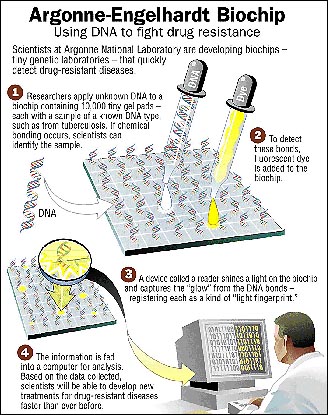
The biochips, which carry out thousands of biochemical reactions simultaneously, have performed well in laboratory tests. "But this will be their first test in the realm of real-world medical diagnostics," said Harvey Drucker, Argonne associate director.
Initial tests will be done on DNA from the tuberculosis bacteria. Clinical research—studies involving patients—is not expected to begin until the method has been proven successful.
"We chose tuberculosis for the tests," Drucker said, "because new drug-resistant strains have sprung up and can easily spread to the whole world. If we can quickly identify specific strains, it will help doctors prescribe the best treatments quickly and possibly help prevent a worldwide epidemic."
Today, tuberculosis patients are often prescribed several antibiotics simultaneously because it takes weeks or months to identify specific tuberculosis strains. Patients can die during this time. "If our biochip can do the job," Drucker said, "physicians can prescribe the most effective treatment without delay."
If successful, these initial studies will set the precedent for similar evaluations of other bacterial and viral diseases.
"With the advanced biochip technology, we'd be able to get all the information we need in a couple of hours," Drucker said, "without any false positives." The researchers are optimistic about this project, he added. "The fact that it has been shown to work, and that the test wasn't difficult to perform, shows us that this has a lot of potential," he said.
The nation's first national laboratory, Argonne National Laboratory supports basic and applied scientific research across a wide spectrum of disciplines, ranging from high-energy physics to climatology and biotechnology. Argonne is operated by the University of Chicago as part of the U.S. Department of Energy national laboratory system.
For more information: Catherine Foster, Argonne National Laboratory, 9700 S. Cass Ave., Argonne, IL 60439. Tel: 630-252-5580. Email: cfoster@anl.gov.